

Why Data Privacy Compliance Matters in 2026
The regulatory landscape has evolved dramatically. Multiple European data protection authorities have declared Google Analytics illegal due to inadequate data transfer safeguards following the Schrems II ruling. France's CNIL introduced a self-assessment framework in July 2025, moving away from pre-approved analytics lists and requiring organizations to verify their tools meet strict conditions: anonymized data, no cross-site tracking, no third-party data sharing, and strict data retention limits (13-month cookie lifespan, 25-month data retention maximum).
The EU's proposed Digital Omnibus initiative may further reshape analytics rules by exempting strictly first-party, aggregated analytics from consent requirements—but only if providers don't reuse data for their own purposes or combine it with other datasets. Meanwhile, the EU-US Data Privacy Framework, while upheld by the General Court in September 2025, faces ongoing appeals to the Court of Justice of the European Union (CJEU), creating uncertainty for companies relying on transatlantic data transfers.
For businesses, non-compliance carries serious consequences: fines up to 4% of global annual revenue under GDPR, reputational damage, and loss of customer trust. The solution lies in adopting analytics tools purpose-built for privacy compliance.
1. Databuddy: Privacy-First Analytics with Full Data Ownership
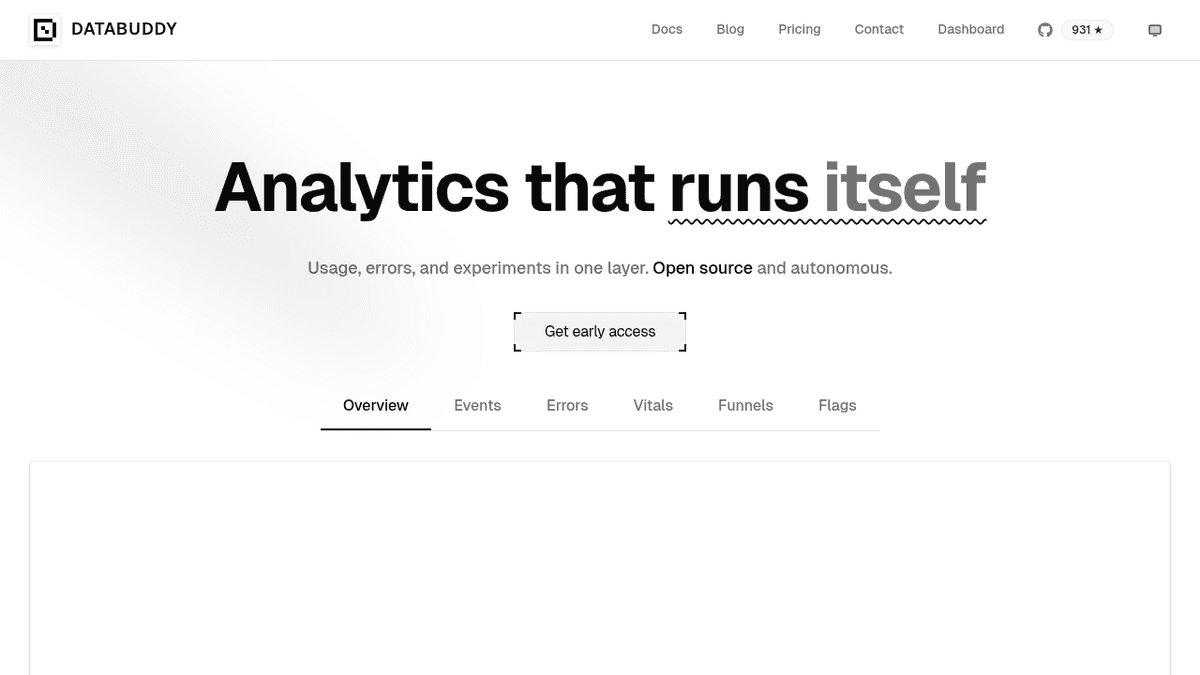
Databuddy offers a comprehensive privacy-focused web analytics platform designed specifically for developers and businesses concerned about GDPR and CCPA compliance. As a modern alternative to Google Analytics, Databuddy eliminates cookies entirely while providing real-time insights, conversion funnel tracking, and performance monitoring.
Key Privacy Features:
Zero cookies: No cookies or fingerprinting technology, eliminating consent banner requirements
GDPR and CCPA compliant by design: Built to meet European and California privacy standards from the ground up
Full data ownership: Your data remains yours, with no third-party sharing or data harvesting
Real-time monitoring: Track user sessions, traffic patterns, and conversions in real-time without compromising privacy
Energy-efficient infrastructure: Reduced carbon footprint through optimized server architecture
Best For: Developers and SMBs seeking straightforward, privacy-compliant analytics with powerful features like conversion funnels, feature flags, and error tracking. Databuddy is ideal for organizations that want to improve user conversions while maintaining complete data control.
Data Residency: Databuddy provides EU data hosting options, ensuring data remains within European jurisdiction for GDPR compliance.
2. Plausible Analytics: Lightweight, Open-Source, and EU-Hosted
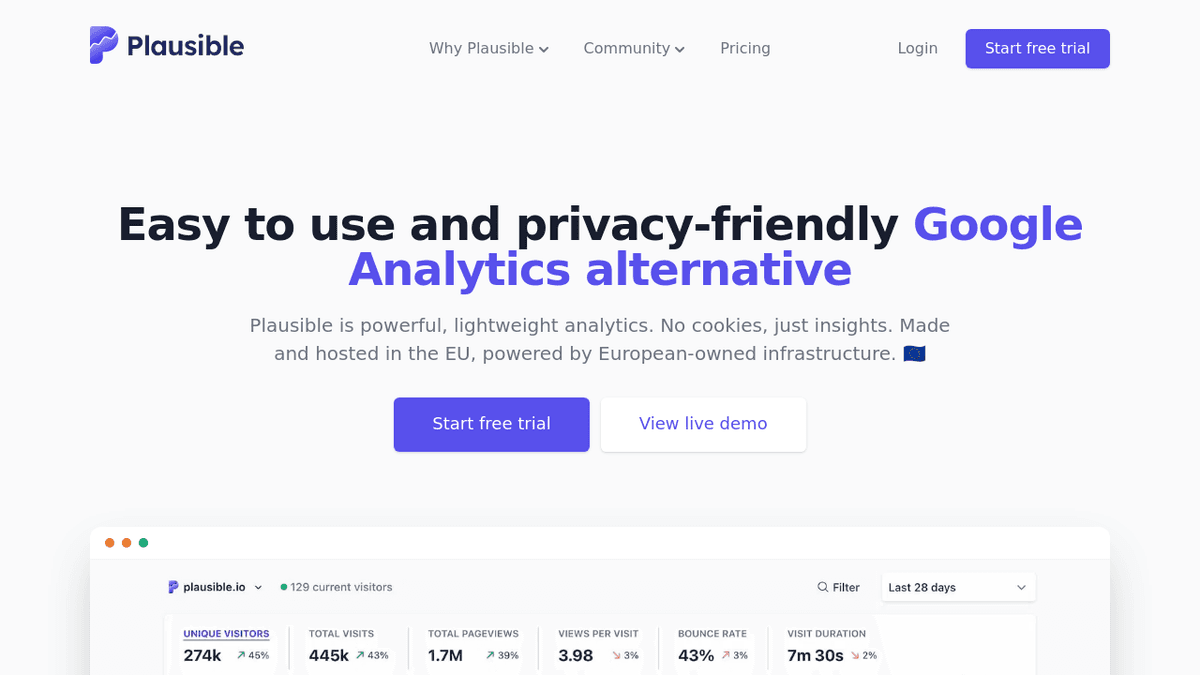
Plausible Analytics has established itself as a leading privacy-first alternative to Google Analytics, offering a remarkably lightweight script (under 1KB) and intuitive dashboard. Trusted by organizations including The Python Software Foundation and the Scottish government, Plausible provides essential web analytics without personal data collection.
Key Privacy Features:
Cookieless tracking: No cookies or local storage used
EU-based hosting: All infrastructure located within the European Union (primarily Germany)
Open-source: Available under AGPL license for self-hosting
GDPR, CCPA, and PECR compliant: Designed to eliminate consent requirements
No cross-site tracking: Data cannot be used to track users across different websites
Best For: Organizations prioritizing simplicity and transparency. Plausible is excellent for content sites, portfolios, and businesses that need essential metrics (page views, referrers, top pages) without complexity.
Data Residency: All data is processed and stored in the EU on Hetzner servers in Germany, ensuring full European data sovereignty.
3. Matomo: Self-Hosted or Cloud with Complete Data Control
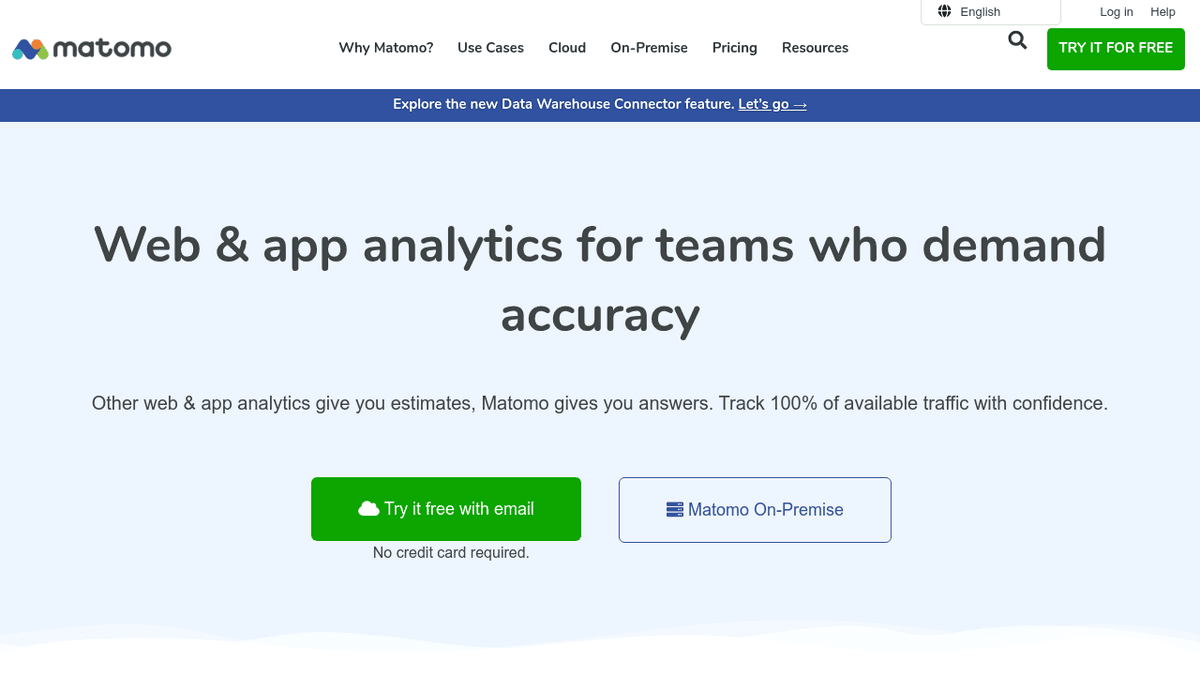
Matomo (formerly Piwik) is the most established open-source analytics platform, offering both self-hosted and cloud-hosted options. With over 1 million websites using Matomo, it provides Google Analytics-level features while maintaining 100% data ownership. Notably, France's CNIL has recognized Matomo as capable of meeting consent exemption requirements when properly configured.
Key Privacy Features:
Self-hosted option: Install on your own servers for complete data control
Cookieless tracking mode: Can operate without cookies when configured appropriately
GDPR Manager: Built-in tool to configure compliance settings
IP anonymization: Automatic pseudonymization and data anonymization features
No data sampling: All data is processed, unlike Google Analytics which samples large datasets
Best For: Enterprises and organizations requiring advanced analytics features with absolute data control. Matomo is ideal for healthcare, finance, and government sectors needing on-premise hosting.
Data Residency: On-premise installations provide complete control over data location. Cloud customers can choose EU data centers (Germany, France). Matomo allows organizations in China to host locally for PIPL compliance.
4. Simple Analytics: EU-Hosted, Cookie-Free, and Minimalist
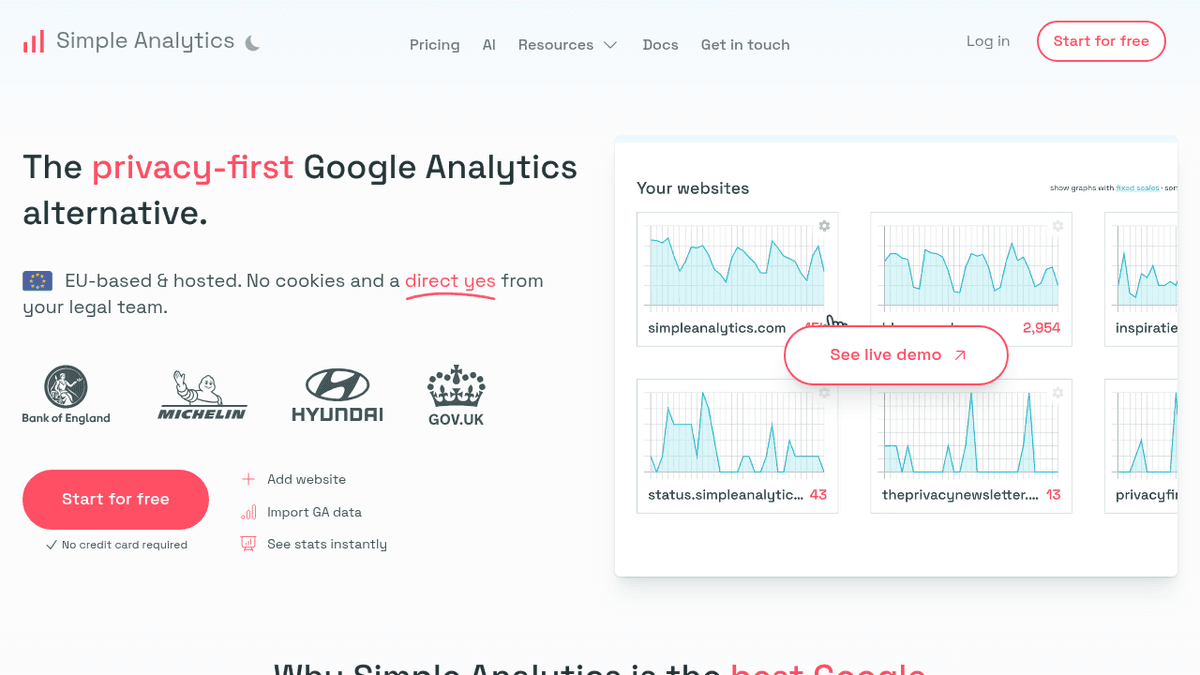
Simple Analytics lives up to its name by providing essential website metrics without collecting any personal data. The platform's strict privacy-first approach means it collects no IP addresses, uses no cookies, and employs no fingerprinting—making it one of the most compliant analytics solutions available.
Key Privacy Features:
Zero personal data collection: No IPs, no cookies, no fingerprinting
EU hosting and ownership: All infrastructure and company based in the Netherlands
GDPR, CCPA, PECR, and TTDSG compliant: Meets European and California standards
ICO-endorsed approach: The UK's Information Commissioner's Office confirmed no consent is required for their methodology
Ad-blocker friendly: Does not appear as intrusive tracking
Best For: Businesses wanting the simplest possible compliance solution. Simple Analytics is perfect for content creators, small businesses, and organizations that value user experience and want to eliminate consent banners entirely.
Data Residency: All data is hosted in the Netherlands and never leaves the EU, providing strong data sovereignty guarantees.
5. Umami: Open-Source, Self-Hosted Analytics
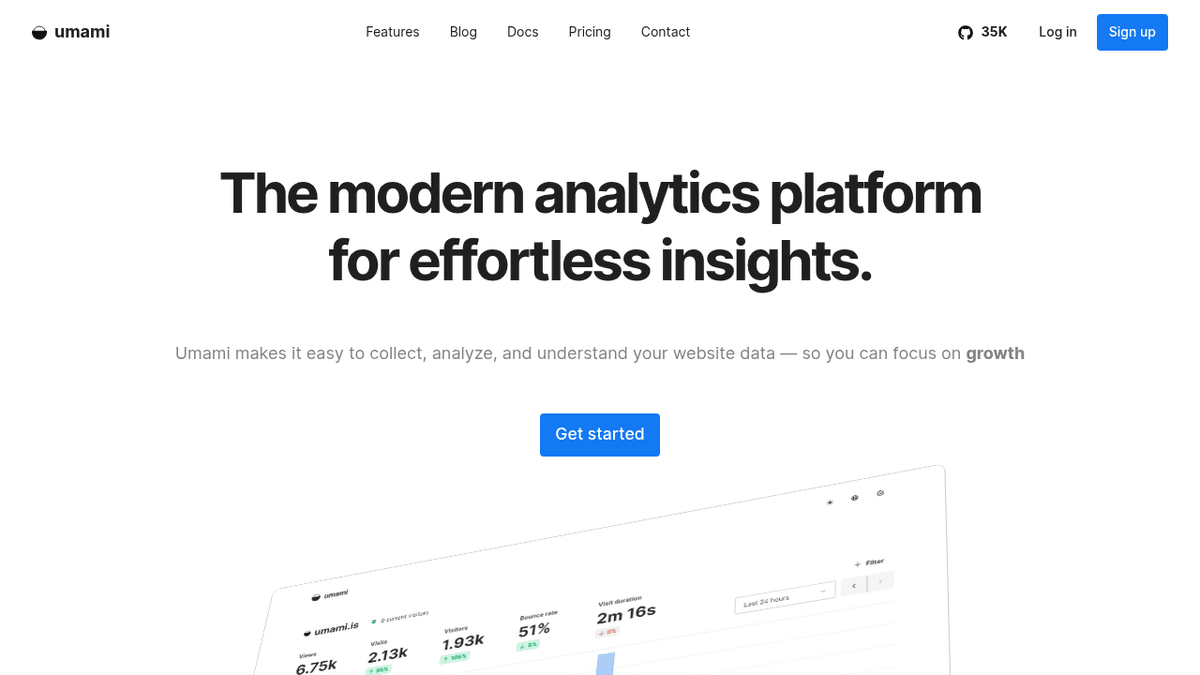
Umami offers an open-source, self-hosted analytics solution that puts complete control in your hands. As a lightweight alternative to Google Analytics, Umami provides essential metrics without collecting personal data, making it an excellent choice for privacy-conscious developers.
Key Privacy Features:
Self-hosted: Deploy on your own infrastructure with full data ownership
No cookies required: Cookieless tracking eliminates consent requirements
GDPR compliant: Designed to respect user privacy by default
Open-source: Available on GitHub under MIT license for transparency and customization
Cloud option available: Managed cloud hosting with EU regions for those preferring hosted solutions
Best For: Developers and technical teams comfortable with self-hosting. Umami is ideal for those wanting cookieless analytics with complete infrastructure control.
Data Residency: Self-hosted deployments allow complete control over data location. Cloud customers can select EU regions for GDPR compliance.
6. Piwik PRO: Enterprise-Grade with EU Sovereignty
Piwik PRO (distinct from Matomo/Piwik) provides an enterprise-focused analytics suite with robust data residency options, including on-premises deployment, private cloud, and public cloud hosting in over 60 Azure regions. The platform emphasizes EU sovereignty, with company ownership and operations based in Europe.
Key Privacy Features:
Multiple hosting options: On-premises, private cloud (Azure, Elastx Sweden), or EU public cloud
GDPR and HIPAA compliant: Suitable for healthcare and financial services
EU-owned and operated: Company and infrastructure based in Europe
Consent management platform: Integrated CMP supporting IAB TCF 2.2
Full data sovereignty: Complete control over data location and access
Best For: Enterprises requiring advanced features, dedicated support, and strict data residency guarantees. Particularly suitable for highly regulated industries like healthcare, finance, and government.
Data Residency: On-premises installations provide absolute control. Cloud customers can choose from EU data centers in Sweden (Elastx), Germany, and the Netherlands, ensuring data never leaves the European Economic Area.
7. Fathom Analytics: Privacy-First with EU Isolation
Fathom Analytics offers a unique "EU Isolation" feature that ensures European visitor data is processed entirely within the EU, with IP addresses never reaching US servers. This approach directly addresses concerns raised by European data protection authorities about transatlantic data transfers.
Key Privacy Features:
EU Isolation: European traffic processed exclusively on EU servers (Germany)
No cookies or personal data: Eliminates consent requirements
GDPR, CCPA, and PECR compliant: Built for strict privacy regulations
Cookieless tracking: Full visitor insights without compromising privacy
SOC 2 Type II certified: Independently verified security and privacy controls
Best For: Businesses with significant European traffic that want robust privacy guarantees without sacrificing ease of use. Fathom is excellent for content sites, SaaS companies, and agencies.
Data Residency: EU Isolation feature ensures European visitor data is processed on Frankfurt and Nuremberg servers (Hetzner) and never transferred to the US.
8. PostHog: Product Analytics with Self-Hosting Options
PostHog provides comprehensive product analytics, feature flags, session recording, and experimentation in a single platform. While offering cloud hosting, PostHog's open-source nature allows complete self-hosting for organizations requiring absolute data control.
Key Privacy Features:
Self-hosting available: Deploy on your infrastructure for complete data ownership
EU cloud region: Hosted option with EU data residency (Frankfurt, Germany)
Cookieless tracking: Can operate without cookies when configured
GDPR compliant: Built with privacy considerations
Open-source: Complete transparency with MIT license
Best For: Product teams needing advanced features like session replays, feature flags, and A/B testing alongside analytics. PostHog suits SaaS companies and product-focused organizations.
Data Residency: Self-hosted deployments provide complete control. Cloud customers can select EU hosting (Frankfurt) to ensure data remains in Europe.
9. Snowplow: Behavioral Data Platform with Private Cloud Deployment
Snowplow offers a sophisticated behavioral data platform designed for enterprises requiring complete data ownership and advanced analytics capabilities. Unlike traditional analytics, Snowplow collects granular, event-level data in your own cloud infrastructure.
Key Privacy Features:
Your infrastructure: Data collected directly into your AWS, GCP, or Azure account
Complete data ownership: First-party data with no third-party access
EU data residency: Deploy in EU regions (Frankfurt, Ireland, Paris)
GDPR and HIPAA support: Suitable for regulated industries
Event-level data: Full control over data structure and retention
Best For: Data-mature enterprises with technical resources requiring granular, first-party data collection for advanced analytics and machine learning.
Data Residency: Customers choose their cloud region during setup. EU deployments in Frankfurt, Ireland, and Paris ensure GDPR compliance through data sovereignty.
10. Countly: Self-Hosted Product Analytics with Global Compliance
Countly provides enterprise-grade product analytics with flexible deployment options including on-premises, private cloud, and public cloud. The platform supports GDPR, HIPAA, and other global privacy regulations through comprehensive security features.
Key Privacy Features:
Self-hosted option: Deploy on your own servers for complete control
GDPR and HIPAA compliant: Suitable for healthcare and financial services
Data residency flexibility: Host anywhere, including EU data centers
Consent management: Built-in features to manage user consent
On-premises security: Air-gapped deployment options for maximum security
Best For: Enterprises requiring mobile and web product analytics with strict data localization requirements. Suitable for organizations in healthcare, finance, and government.
Data Residency: On-premises installations provide absolute control over data location. Cloud deployments can be configured for EU hosting to meet GDPR requirements.
Special Considerations for Specific Regions
European Union: GDPR and ePrivacy
Organizations operating in the EU must prioritize tools that offer EU data residency, cookieless tracking, and alignment with CNIL's consent exemption criteria. The self-assessment framework introduced in 2025 requires analytics to:
Measure audience exclusively for the site owner
Not combine data with other datasets
Implement strict data retention (13-month cookie maximum, 25-month data retention)
Provide clear opt-out mechanisms
Anonymize IP addresses (remove last octet)
Tools like Databuddy, Plausible, Matomo (when configured properly), and Simple Analytics meet these requirements by design.
China: PIPL Data Localization
China's Personal Information Protection Law (PIPL) mandates strict data localization for companies processing personal information of Chinese users, particularly those designated as Critical Information Infrastructure Operators (CIIOs) or handling data of over 1 million users. Organizations must:
Store all personal data within mainland China
Conduct mandatory data protection compliance audits (effective May 1, 2025)
Obtain explicit consent for any cross-border data transfer
Appoint a Personal Information Protection Officer (PIPO)
For PIPL compliance, self-hosted solutions like Matomo, Umami, or Countly deployed on Chinese cloud infrastructure (e.g., AWS China, Alibaba Cloud) are essential.
United States: CCPA and State Privacy Laws
While US privacy laws are generally less restrictive than GDPR, California's CCPA and similar state laws require businesses to:
Disclose data collection practices
Allow users to opt out of data sales
Provide data deletion rights
Implement reasonable security measures
Most privacy-first analytics tools (Databuddy, Plausible, Simple Analytics, Fathom) meet CCPA requirements by not collecting or selling personal data.
Making the Right Choice: Decision Framework
When selecting an analytics tool for regions with strict data privacy laws, consider:
1. Data Residency Requirements
Does your jurisdiction require data to remain in-country or in-region?
Do you need proof of data location for compliance audits?
2. Hosting Flexibility
Will a cloud-hosted solution suffice, or do you need self-hosted/on-premises deployment?
What technical resources do you have for managing self-hosted infrastructure?
3. Feature Requirements
Do you need basic website analytics or advanced product analytics?
Are features like session recording, feature flags, or A/B testing essential?
4. Compliance Certifications
Do you require specific certifications (HIPAA, SOC 2, ISO 27001)?
Does your industry have special compliance needs?
5. Budget and Scale
What is your traffic volume and budget?
Do you need enterprise support and SLAs?
Implementation Best Practices
Regardless of which tool you choose, follow these implementation best practices:
Configure for Maximum Privacy:
Enable all available privacy features (IP anonymization, cookieless mode)
Set the shortest acceptable data retention period
Disable any features that collect personal data
Update Privacy Documentation:
Update your privacy policy to accurately describe your analytics tool
Explain what data is collected and how it's used
Provide clear opt-out mechanisms if required
Test Compliance:
Verify no cookies are set (use browser developer tools)
Confirm data is stored in the correct region
Test that no personal data is collected
Monitor Regulatory Changes:
Stay informed about evolving privacy regulations
Subscribe to updates from relevant data protection authorities
Review your analytics setup annually
The Future of Privacy-Compliant Analytics
The trajectory is clear: privacy-first analytics is no longer optional but essential. The EU's Digital Omnibus proposal may formally exempt properly configured, first-party analytics from consent requirements, further encouraging adoption of privacy-focused tools. Meanwhile, ongoing challenges to data transfer frameworks necessitate solutions that process data locally.
Organizations that proactively adopt privacy-compliant analytics gain competitive advantages: improved user experience through elimination of consent banners, reduced legal risk, enhanced customer trust, and future-proof infrastructure aligned with regulatory trends.
Whether you choose Databuddy for its comprehensive privacy-first approach and real-time insights, Plausible for its simplicity, Matomo for its feature richness, or another solution on this list, the key is selecting a tool that aligns with your specific compliance requirements, technical capabilities, and business needs.
Conclusion
Navigating analytics in regions with strict data privacy laws requires careful tool selection and proper configuration. The ten solutions highlighted here—Databuddy, Plausible, Matomo, Simple Analytics, Umami, Piwik PRO, Fathom, PostHog, Snowplow, and Countly—each offer unique strengths for different organizational needs.
For most businesses seeking a balance of powerful features, ease of use, and strong privacy compliance, modern privacy-first platforms like Databuddy provide the ideal solution. With zero cookies, full data ownership, and GDPR/CCPA compliance by design, Databuddy enables organizations to gather essential insights while respecting user privacy and maintaining regulatory compliance.
The era of privacy-compromising analytics is ending. By choosing tools built for compliance from the ground up, businesses can maintain both legal adherence and valuable insights—without compromise.