
Google Analytics 4 ships a 45KB tracking script, fires data to US-based servers, and has been declared non-compliant by data protection authorities in Austria, France, Denmark, and Italy. If you're a developer or engineering-led team operating under GDPR or CCPA, that's not a minor inconvenience — it's a legal liability.
The good news: the open-source analytics ecosystem in 2026 is genuinely strong. Whether you need a dead-simple pageview counter, a full product analytics suite, or something in between, there's a self-hostable or privacy-native option that fits. This list covers the seven best tools, ranked by use case, so you can match the right one to your stack.
What to look for in an open-source analytics tool
Before getting into the list: "open-source" means different things depending on the vendor. Some tools are fully open-source under permissive licenses (MIT, Apache 2). Others offer a source-available or BSL-licensed core with proprietary cloud features gated behind a paywall. For each tool below, the license and self-hosting situation is called out explicitly.
Key evaluation criteria:
- License: MIT, Apache 2, AGPL, or BSL — and what that means for self-hosting
- Script weight: Directly impacts Core Web Vitals and LCP
- Cookieless by default: No cookies = no consent banners under GDPR Recital 30
- Data ownership: Where data lives and who can access it
- Feature depth: Pageviews only vs. funnels, session replay, feature flags
1. Databuddy — best for developer teams that want full-stack analytics without compliance overhead

Databuddy is a cookieless, GDPR- and CCPA-compliant analytics platform built for developers and product teams who need more than basic traffic data — without the compliance baggage of GA4 or the infrastructure overhead of a fully self-hosted stack. The tracking script weighs under 3KB and operates with zero cookies or fingerprinting, so there's no consent banner required under most EU and US privacy frameworks.
What separates Databuddy from simple pageview counters is the depth of its product analytics layer. It includes real-time session monitoring, conversion funnel analysis, feature flag management, error tracking, and Core Web Vitals reporting — all in one dashboard. Databuddy vs Google Analytics shows the full feature delta, but the short version is: same actionable insights, a fraction of the script weight, and no data leaving your control to Google's servers.
Trusted by teams at OpenCut and BETTER-AUTH, Databuddy suits startups and mid-sized companies where the engineering team sets the analytics requirements and privacy compliance is non-negotiable.
License: Proprietary SaaS (source-available components on GitHub) Cookieless: Yes, by default Self-hosted: Managed cloud with full data ownership Best for: Developer-led teams, SaaS products, privacy-strict environments
2. Matomo — best for organizations that need a full GA4 replacement on their own servers
Matomo (formerly Piwik) is the most feature-complete open-source analytics platform available, and it's been around since 2007. If your organization needs the full Google Analytics 4 feature surface — heatmaps, session recordings, A/B testing, custom dimensions, goals, e-commerce tracking — and you want every byte of that data stored on infrastructure you control, Matomo is the reference implementation.
The self-hosted version is free under AGPL-3.0. The cloud version starts at around $23/month. The trade-off is operational overhead: Matomo runs on PHP + MySQL, requires a capable server (particularly as data volumes grow), and the tracking script comes in at ~23KB — roughly 8x heavier than lightweight alternatives. According to a March 2026 comparison by OpenPanel.dev, Matomo is also the only self-hosted tool that gates some advanced features (heatmaps, session recordings) behind paid plugin licenses even on self-hosted deployments.
License: AGPL-3.0 (self-hosted), proprietary (cloud) Cookieless: Optional (consent mode available) Self-hosted: Yes, free Best for: Enterprise teams, organizations with strict on-premise data requirements
See how Matomo compares on key dimensions at Databuddy's alternative to Matomo.
3. Plausible Analytics — best lightweight, cookieless tracker for content sites and marketing teams

Plausible is the clearest counterpoint to GA4 complexity. The tracking script is under 1KB — approximately 45x smaller than Google Analytics. There are no cookies, no personal data collected, no cross-site tracking. The dashboard is a single page that shows sessions, pageviews, bounce rate, top referrers, and goal conversions. That's intentionally the whole feature set.
The community edition is open-source under AGPL-3.0 and self-hostable via Docker. The managed cloud service starts at $9/month. One thing worth noting for 2026: self-hosting Plausible requires more infrastructure than its simplicity suggests — Elixir, PostgreSQL, and ClickHouse all run concurrently, so a modest VPS won't cut it for high-traffic sites. The hosted plan often makes more operational sense unless you have a dedicated DevOps function.
For teams that need conversion funnel tracking or session-level behavioral data, Plausible will feel limiting. But for content-heavy sites and marketing teams that just need traffic dashboards, it's hard to beat the simplicity.
License: AGPL-3.0 (self-hosted community edition) Cookieless: Yes Self-hosted: Yes (requires Elixir + ClickHouse stack) Best for: Blogs, content sites, simple SaaS marketing pages
4. Umami — best minimalist self-hosted analytics for developers who want a clean setup
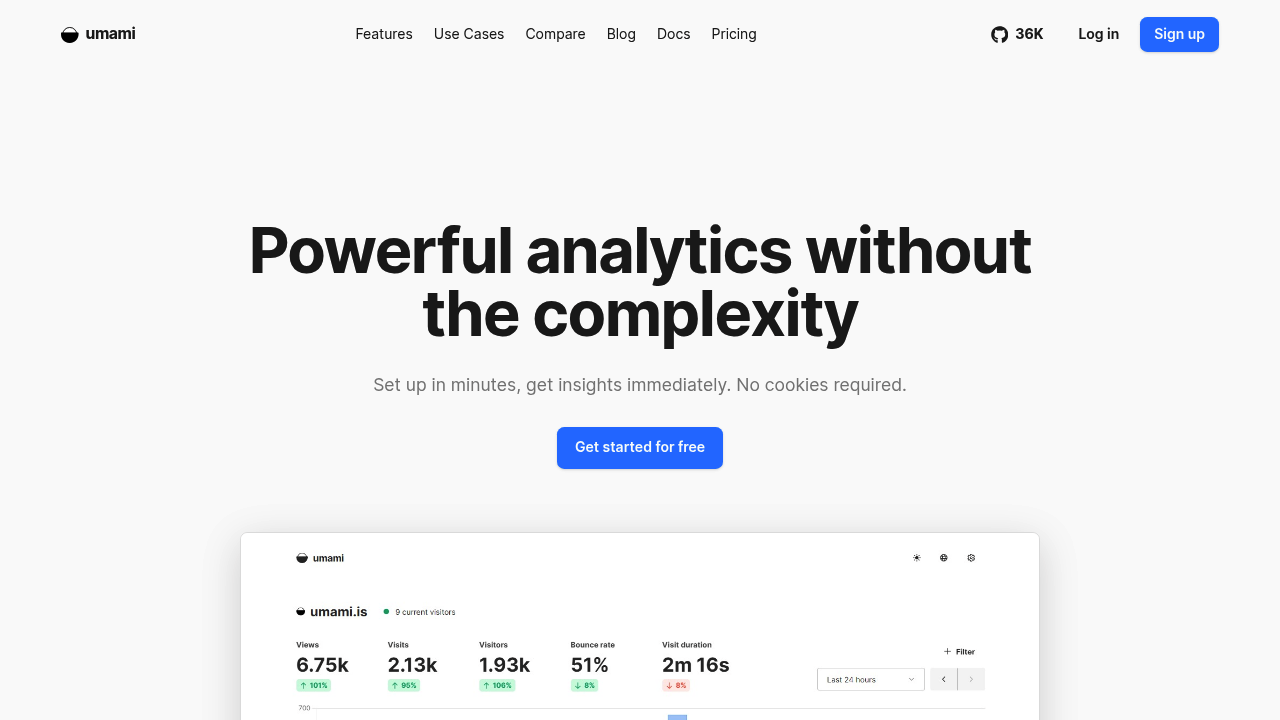
Umami is a Next.js-based analytics platform that runs on Node.js with PostgreSQL or MySQL. It's MIT-licensed, genuinely simple to deploy, and the dashboard is clean enough that non-technical stakeholders can read it without a tutorial. The tracking script is very lightweight, cookieless by default, and GDPR-compliant out of the box.
Where Umami wins over Plausible for self-hosters is the simpler infrastructure stack — no Elixir or ClickHouse required. A standard Node + Postgres setup on a cheap VPS handles it. According to a November 2024 community comparison on the r/selfhosted subreddit, Umami collects more complete data than Plausible in certain edge cases (particularly around SPA routing), while remaining easier to self-host than Matomo.
The ceiling is fairly low, though. No session replay, no funnel analysis beyond basic goal tracking, no feature flags. If those matter to your team, Umami will feel like a dead end fairly quickly. But for a developer spinning up a side project or internal tool that needs basic traffic visibility, it's one of the fastest paths from zero to working analytics.
For a direct comparison of Umami against a more feature-rich option, see Databuddy vs Umami.
License: MIT Cookieless: Yes Self-hosted: Yes (Node.js + PostgreSQL/MySQL) Best for: Developers, side projects, internal tools, lean self-hosted setups
5. PostHog — best open-source product analytics suite for SaaS teams
PostHog is less of a web analytics tool and more of a product engineering platform. It ships session replay, event-based funnels, cohort analysis, feature flags, A/B testing, and a data warehouse connector — all under one MIT-licensed codebase. For SaaS teams building data-driven products, this is genuinely powerful.
The self-hosted version is free with unlimited events. The cloud version has a generous free tier (1M events/month) then charges at volume. The trade-off everyone encounters: PostHog's default script is ~52KB according to a February 2026 comparison by OpenPanel.dev, and self-hosting requires serious infrastructure — ClickHouse, Kafka, Redis, and multiple worker services running concurrently. It's closer to deploying a data platform than installing an analytics tool.
PostHog also doesn't operate cookieless by default. You can configure it to avoid cookies, but that requires deliberate setup and documentation review. Teams operating under strict GDPR requirements should factor in the configuration overhead.
For teams that want PostHog-level feature depth with a lighter operational footprint, Databuddy vs PostHog breaks down where each tool makes sense.
License: MIT (core), proprietary (some cloud features) Cookieless: Configurable (not default) Self-hosted: Yes (requires Kafka + ClickHouse cluster) Best for: Product engineering teams, SaaS companies, teams doing active experimentation
6. Rybbit — best modern open-source GA4 replacement with session replay
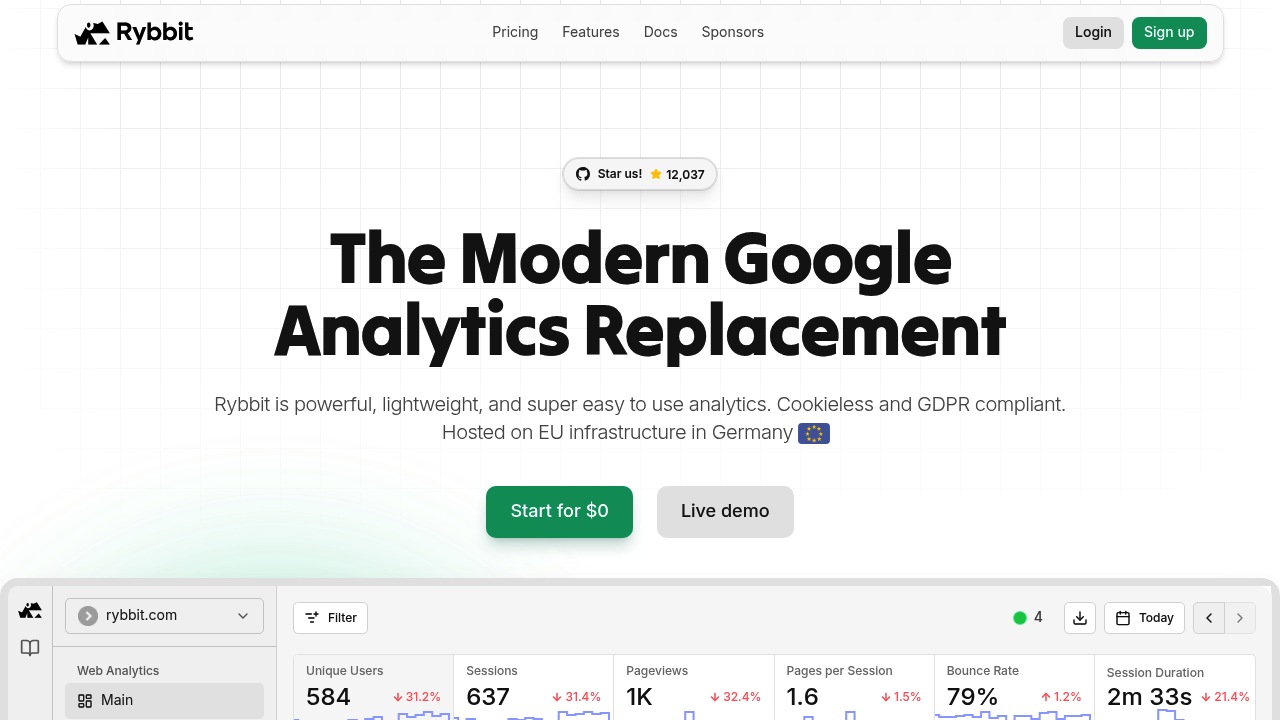
Rybbit launched in 2025 and has moved quickly — v2.4.0 (released February 2026 per the r/selfhosted community) ships autocapture for button clicks and form submissions, a revamped user journey visualization, a real-time event stream, and session replay. The whole thing is AGPL-3.0-licensed and self-hostable via Docker Compose.
What makes Rybbit notable in 2026 is the combination of a modern UI, genuinely useful default captures (not just pageviews), and a free self-hosted tier that doesn't gate features behind a paywall. The managed cloud offers 10,000 events/month free, which is workable for early-stage projects. Built-in web vitals tracking (LCP, CLS, INP, FCP) puts it ahead of many competitors on the performance monitoring side.
The caveat: it's a newer project maintained by a small team. The API surface is still maturing, and there's less community tooling than Matomo or Plausible. For teams comfortable running a relatively young open-source project in production, Rybbit is one of the more exciting options to watch.
License: AGPL-3.0 Cookieless: Yes Self-hosted: Yes (Docker Compose) Best for: Developers who want modern UI + session replay without paying for Hotjar
7. GoatCounter — best ultra-minimal analytics for developers who want just the numbers
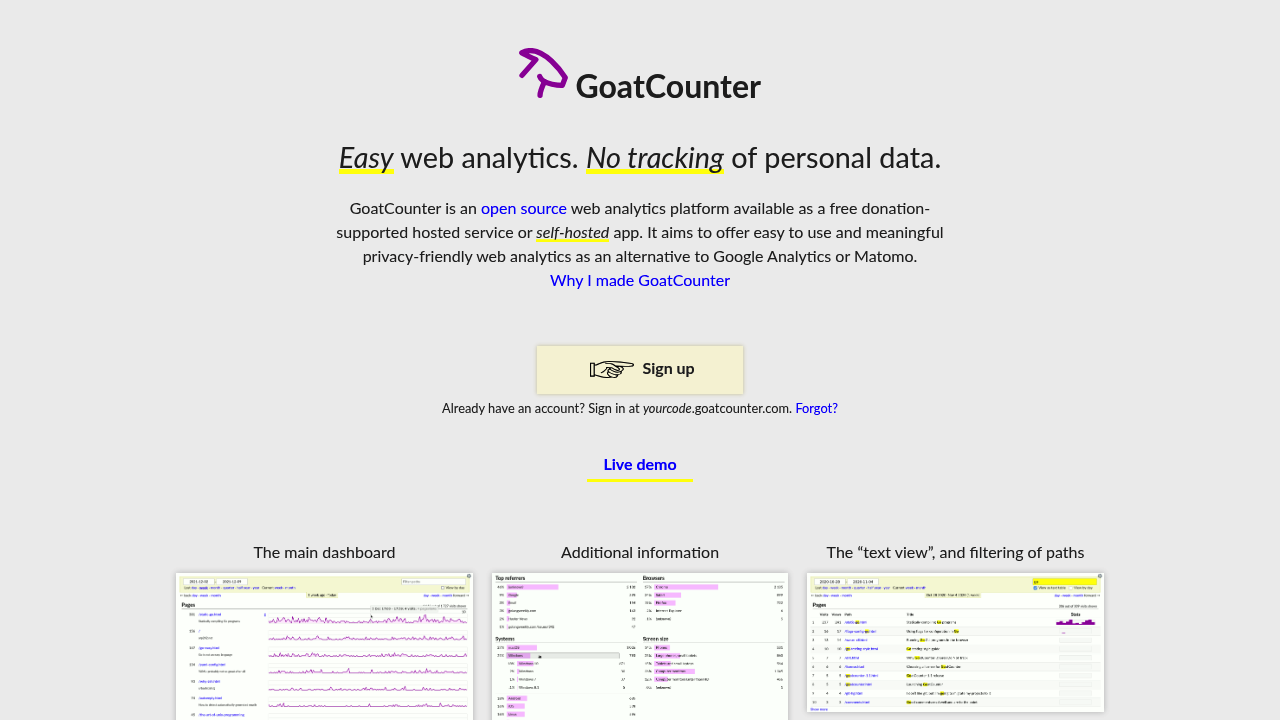
GoatCounter is the anti-GA4. It's a single Go binary, runs on SQLite or PostgreSQL, uses ~3.5KB of tracking script, stores no personal data, and requires no cookie consent banner under GDPR. The hosted version is free for non-commercial use and donation-supported. Self-hosting requires virtually no infrastructure — a small VPS and a domain is enough.
The feature set is minimal by design: pageviews, referrers, browser/OS/device data, and basic geographic data at the country level. No funnels, no user journeys, no session replay. GoatCounter's own documentation is upfront about this — the tool targets developers and indie hackers who find GA4's complexity actively counterproductive and want a low-maintenance, privacy-respecting pageview counter that just works.
One known limitation: multi-domain tracking isn't natively supported in a single dashboard view. Each subdomain requires its own GoatCounter site, which can be friction for larger projects.
License: EUPL-1.2 (self-hosted), hosted service (free for non-commercial) Cookieless: Yes Self-hosted: Yes (single Go binary + SQLite) Best for: Personal projects, open-source projects, developers who want zero-overhead traffic data
Quick comparison: which tool fits which use case
| Tool | Script size | Self-hosted | Cookieless default | Session replay | Feature flags | Best for |
|---|---|---|---|---|---|---|
| Databuddy | ~3KB | Managed cloud | ✅ | ✅ | ✅ | Dev teams, SaaS, compliance-first |
| Matomo | ~23KB | ✅ Free | Optional | Paid plugin | ❌ | Enterprise, on-premise |
| Plausible | <1KB | ✅ Paid | ✅ | ❌ | ❌ | Content sites, marketing |
| Umami | Very light | ✅ Free | ✅ | ❌ | ❌ | Lean self-hosted, side projects |
| PostHog | ~52KB | ✅ Free | Configurable | ✅ | ✅ | Product engineering, SaaS |
| Rybbit | Light | ✅ Free | ✅ | ✅ | ❌ | Modern GA4 replacement |
| GoatCounter | ~3.5KB | ✅ Free | ✅ | ❌ | ❌ | Minimal pageview tracking |
How to choose
You need a drop-in GA4 replacement with compliance guaranteed out of the box: Databuddy or Matomo. Databuddy if you want managed infrastructure and modern product analytics; Matomo if you need on-premise deployment at all costs.
You want the simplest possible self-hosted setup: Umami (Node.js stack) or GoatCounter (single binary). Both cover basic traffic analytics with minimal ops overhead.
You're building a SaaS product and need behavioral data, not just traffic stats: PostHog for the full engineering platform, Databuddy if you want real-time analytics without cookie consent forms bundled with feature flags and error tracking in a lighter package.
You're sensitive to script weight and Core Web Vitals: Plausible (<1KB) or GoatCounter (~3.5KB). Both are cookieless and won't move your LCP numbers.
You want session replay as part of your open-source stack: Rybbit (free self-hosted) or PostHog. Matomo offers it too but only via paid plugins.
Privacy regulations aren't getting looser. The EU enforcement trend in 2026 continues to favor tools that don't transfer data to non-EU servers by default — and that's exactly where GDPR-compliant analytics tools outperform the legacy GA4 setup. Whichever tool you pick from this list, you're moving in the right direction.