
Cookie consent banners are now a permanent fixture of the web — and the numbers behind them are brutal. According to a 2025 survey cited by Humblytics, over 48% of users reject cookie consent when prompted, and roughly 40% run ad blockers. That means nearly half your funnel data can vanish the moment a visitor clicks "decline."
The pressure to go cookieless isn't just regulatory anymore. It's a measurement problem. If your conversion funnel analysis depends on cookies and a user rejects your consent prompt at the landing page, the rest of their journey — the pricing page visit, the signup, the first purchase — is invisible.
So what actually works in 2025? Below is a breakdown of the tools best suited to track multi-step conversion funnels without relying on cookies, along with honest notes on where each one has real limitations.
Why cookies and conversion funnels don't mix well anymore
First-party cookies in a strict technical sense haven't disappeared — Google reversed its Chrome deprecation plan in April 2025, opting instead for a user-choice model where third-party cookies remain enabled by default. But that decision doesn't solve the core problem: GDPR, CCPA, and similar regulations still require informed consent before any tracking, and users are increasingly denying it.
Server-side tracking research from migrateanalytics.com shows that setups bypassing client-side cookie restrictions recover 10–20% more attributed conversions compared to standard browser-based implementations. For any team running meaningful conversion optimization, that delta is the difference between useful funnel data and noise.
The tools below either eliminate cookies entirely by design or give you a configuration path to run fully cookieless — while still delivering actionable funnel analysis.
1. Databuddy — cookieless by architecture, not by configuration
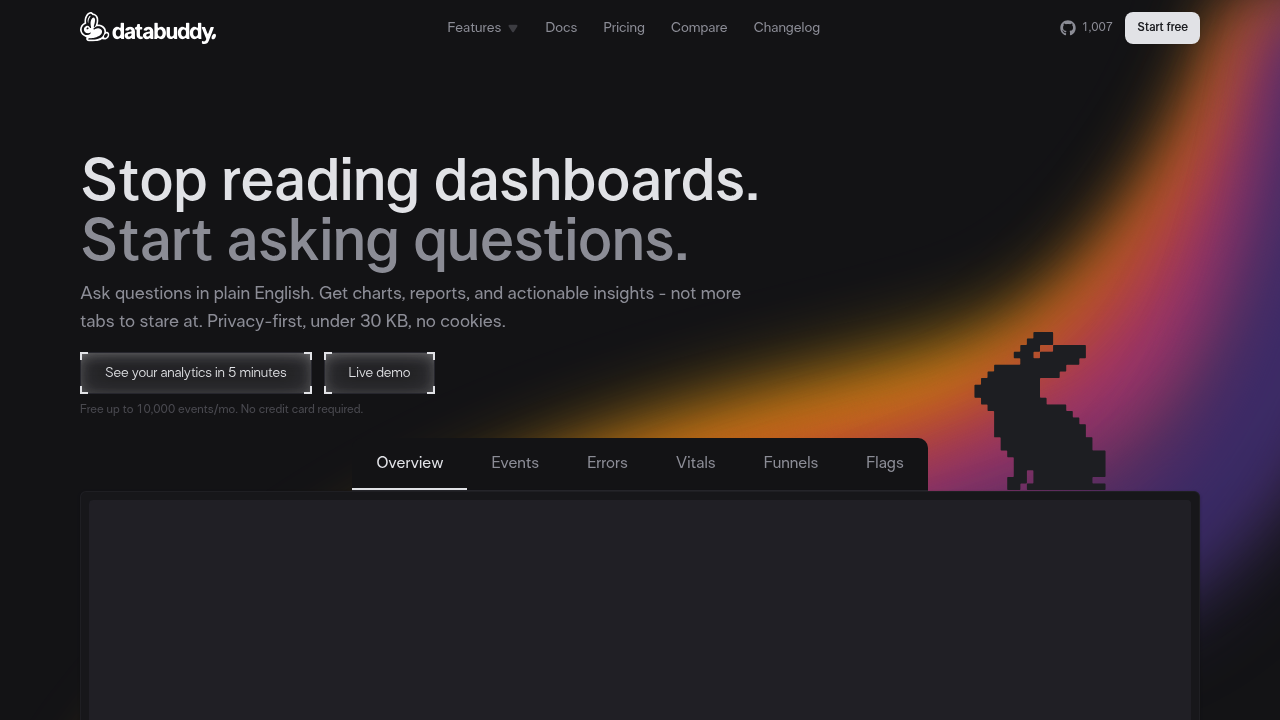
Databuddy is built cookieless from the ground up — no toggle required, no opt-out configuration, no "force tracking without cookies" checkbox buried in a settings panel. The platform uses no cookies and no fingerprinting, relying instead on privacy-safe aggregated session analysis to deliver real-time funnel data that's fully GDPR and CCPA compliant out of the box.
Conversion funnel tracking in Databuddy is event-driven: you define the steps using custom events or pageview goals, and the platform maps the drop-off at each stage. You get real-time session monitoring, full data ownership — your data never transits to third-party infrastructure — and a 3KB tracking script that won't impact your Core Web Vitals. The platform also includes feature flag management for progressive rollouts, letting you measure funnel performance across different UI variants without any additional tooling.
For teams that are switching from cookie-dependent platforms like Google Analytics or Mixpanel, Databuddy's approach is the cleanest path: zero consent banner overhead, zero cookie compliance risk, and funnel data that reflects your entire audience — not just the segment that said yes to tracking.
Best for: Developers and product teams who want production-grade funnel analytics without any cookie infrastructure at all.
2. Plausible Analytics — lightweight and funnel-capable
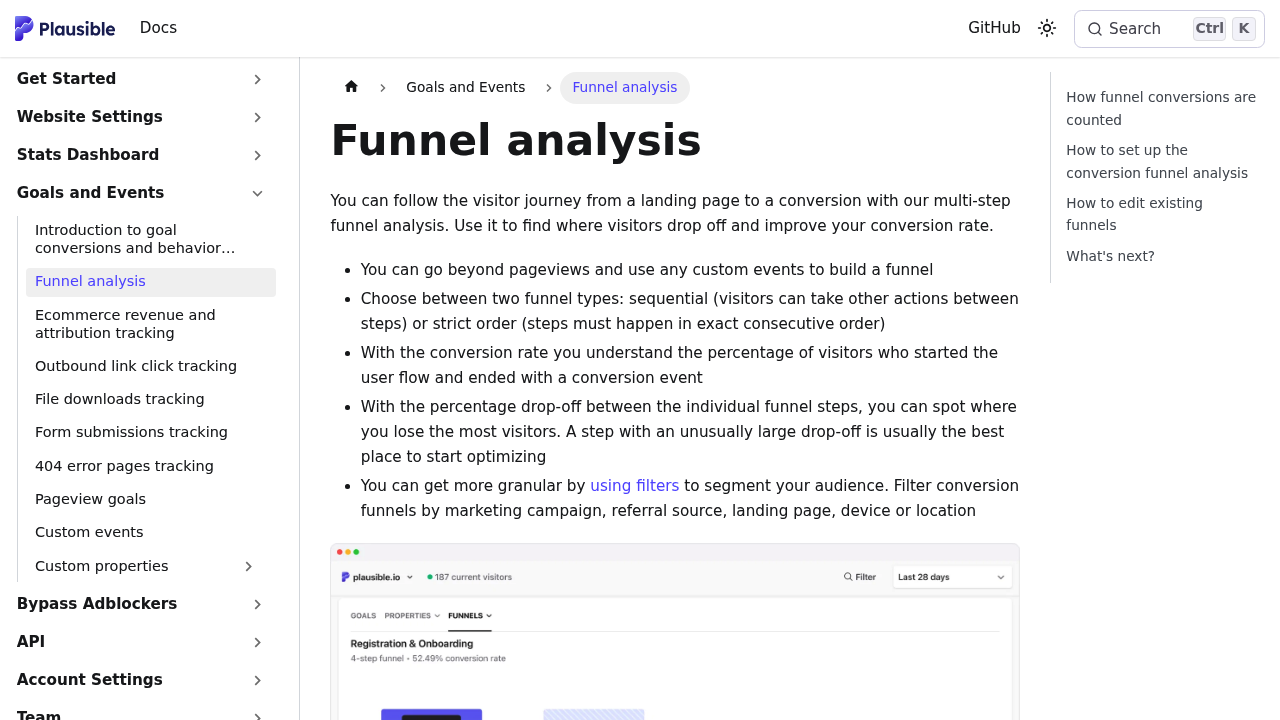
Plausible doesn't use cookies and doesn't generate persistent identifiers. Its tracking script weighs under 1KB — about 45 times smaller than Google Analytics — and unique visitor counts are derived from a daily-rotating hash of the IP address, browser, and OS, which means there's no cross-session or cross-site profiling.
The funnel feature allows you to define sequences of up to 8 steps using pageview goals or custom events. You can configure strict funnels (only sequential completions count) or more flexible ones that allow intermediate actions. For teams that need to understand drop-off between, say, a pricing page and a checkout flow, Plausible's funnel analysis delivers that without any consent overhead.
Plausible is hosted in the EU and self-hosting is available for teams with strict data residency requirements.
Best for: Teams that want simple, accurate funnel tracking with minimal setup and zero cookie compliance overhead. Not the right fit if you need session-level or user-level path analysis.
3. Matomo — full-featured cookieless mode
Matomo (formerly Piwik) is an open-source analytics platform that has supported cookieless tracking since long before it became a mainstream concern. Enabling it is a configuration change: navigate to Privacy > Anonymize data and check "Force tracking without cookies." From that point, Matomo uses a session-scoped hash rather than persistent cookie identifiers.
The Funnels plugin (available on both cloud and self-hosted plans) lets you build visual multi-step funnel reports using pages, events, or external referrals as steps. The reports show entry counts, completion rates, and drop-off at each stage. Crucially, because Matomo is self-hosted or operates under your domain in cloud mode, the data never leaves your infrastructure.
France's CNIL has explicitly recognized Matomo's cookieless mode as exempt from the consent requirement under certain configurations — a distinction that matters for EU-based operations.
The trade-off: cookieless mode limits cross-session user tracking. Funnel reports work at the session level, which is fine for most conversion optimization use cases but doesn't support long-horizon cohort analysis. The Databuddy vs Matomo comparison covers the architectural differences if you're evaluating both.
Best for: Teams that need comprehensive funnel analytics with full data ownership and regulatory flexibility. Best suited for organizations comfortable managing their own infrastructure.
4. Piwik PRO — anonymous tracking with enterprise-grade funnels
Piwik PRO's anonymous tracking mode uses a randomized session hash instead of cookies, and it's designed specifically for organizations operating in strict GDPR environments where consent rates are low. According to Piwik PRO's own documentation, pairing their platform with a compliant CMP can recover data from up to 98% of traffic — including the visitors who reject cookies.
Funnel reports in Piwik PRO track user journeys at the session level, mapping conversion steps through pages, custom events, and cross-domain interactions. The platform's built-in consent manager handles dual-mode tracking: consented visitors get full profiling, non-consenting visitors are tracked anonymously — and both groups feed into the funnel reports.
This makes Piwik PRO particularly practical for organizations that can't simply switch off consent management entirely but still need accurate funnel data from non-consenting visitors.
Best for: Enterprise teams and regulated industries (healthcare, finance, public sector) that need high-accuracy funnel tracking under strict consent requirements.
5. PostHog — configurable cookieless mode for product analytics
PostHog is an open-source product analytics platform that supports cookieless operation via its persistence: 'memory' configuration option. When set, PostHog stores no data in cookies or localStorage — everything stays in-memory for the duration of the session.
For teams that want to maintain a consent banner workflow, PostHog's cookieless_mode: 'on_reject' configuration will prevent cookie and localStorage writes only when users actively decline. This keeps full tracking functionality for users who consent while staying GDPR-compliant for those who don't.
PostHog's funnel analysis is detailed: multi-step funnels with conversion window controls, breakdown by user properties, and correlation analysis that surfaces which behavioral attributes predict funnel completion or abandonment.
The limitation in full cookieless mode is meaningful: without persistent identifiers, PostHog can't stitch together returning users across sessions, which affects the accuracy of multi-session funnels, retention curves, and long-term cohort analysis. For session-contained funnel analysis, it works well; for cross-session user journeys, you'll need to pass explicit user IDs via posthog.identify(). See the Databuddy vs PostHog comparison for a feature-level breakdown.
Best for: Product engineering teams that need deep behavioral funnel analysis and are comfortable with the session-scoping limitations of in-memory persistence.
6. Mixpanel — cookieless via server-side tracking
Mixpanel's JavaScript SDK uses first-party cookies and localStorage by default, but both can be disabled. Setting disable_persistence: true during initialization prevents any client-side storage, meaning Mixpanel won't write to cookies or localStorage at all.
The real-world implication: with persistence disabled, each page load creates a new anonymous identity. Multi-step funnel tracking becomes unreliable unless you're either (a) running server-side event ingestion via Mixpanel's HTTP API, or (b) explicitly passing a consistent distinct_id — typically a logged-in user's ID — with every event.
For product teams that authenticate users early in their funnel (e.g., a SaaS signup flow), this works well: call mixpanel.identify(userId) immediately on authentication, and all subsequent events are stitched to that profile without any cookie dependency. Mixpanel's funnel analysis is powerful once the identity graph is consistent — multi-step visualization, conversion window controls, and breakdown by event properties are all available.
Server-side event ingestion via Mixpanel's HTTP API bypasses browser restrictions entirely and is the most reliable path for cookieless funnel tracking at scale. Switching from Mixpanel to a natively cookieless platform is an option worth evaluating if maintaining this infrastructure layer feels like unnecessary overhead.
Best for: Product teams with authenticated user flows who can anchor funnel tracking to explicit user IDs rather than anonymous browser identifiers.
7. Amplitude — cookieless with identityStorage: 'none'
Amplitude's Browser SDK 2 supports disabling all cookie and localStorage persistence by setting identityStorage: 'none' during initialization. This prevents Amplitude from writing its amp_* cookies and forces a new device ID on every session.
As with Mixpanel, cookieless mode in Amplitude requires passing a consistent userId immediately upon user authentication to keep funnel steps connected across the conversion journey. Without this, each session is treated as a new anonymous user, making cross-session funnel analysis effectively impossible.
Amplitude's funnel analysis capabilities are strong: configurable conversion windows (by session, by day, by week), ordered vs. unordered step modes, and behavioral cohorts based on funnel completion or abandonment. The platform also supports deferred initialization (deferInitialization: true) to prevent any tracking before consent is given — a cleaner implementation than a full opt-out on initialization.
Amplitude is better suited for Amplitude alternatives evaluation if your team wants cookieless behavior without engineering overhead around identity management.
Best for: Data teams running product-led growth analytics on authenticated applications where user IDs can be passed reliably at login.
How to choose the right approach
The tools above fall into two categories that map to different engineering contexts:
Cookieless by design (Databuddy, Plausible, Matomo in cookieless mode) require no configuration to be privacy-compliant and work immediately without a consent banner. Funnel data reflects all visitors, not just those who consented. These are the right choice when you want zero cookie infrastructure, full GDPR compliance without consent management, and funnel data that represents your actual traffic.
Configurable cookieless (PostHog, Mixpanel, Amplitude) ship with cookie-based defaults and require deliberate configuration to disable persistence. They unlock more sophisticated funnel analysis — user-level stitching, cross-session journeys, behavioral cohorts — but only when paired with authenticated identity management. For anonymous visitor funnels, their cookieless modes are functionally equivalent to the simpler tools above.
If you're dealing with anonymous pre-authentication funnels (landing page → pricing → signup), a natively cookieless platform gives you cleaner data with less infrastructure. If you're tracking post-authentication product funnels (onboarding → activation → conversion), a configurable platform with server-side identity resolution may deliver more depth.
The question isn't whether cookieless tracking is good enough. At this point, for most funnel use cases, it's more accurate — because it counts everyone, not just the users who clicked "accept." The cookieless analytics guide walks through the technical implementation patterns in more detail if you're mid-migration.
What funnel tracking setup is your team using right now? Drop a comment — curious whether the consent-rejection data loss problem is as significant for others as the numbers suggest.