
If you've ever watched a significant chunk of your analytics data vanish after deploying a cookie consent banner, you already know the problem. According to a 2025 benchmark study by etracker, legally compliant cookie banner designs result in cookies being rejected in 60% of visits. Advance Metrics data puts the average consent rate at just 25.4% for first-level cookie acceptance. That means three-quarters of your visitors may never appear in your analytics at all.
The good news: custom event tracking — button clicks, form submissions, purchase completions, video plays, funnel steps — doesn't require cookies to work. A growing set of platforms can fire and collect these events using first-party, session-based, or fully anonymous data pipelines that never touch the cookie jar.
Here's a breakdown of five analytics platforms that give you full custom event tracking without any cookie dependency.
How cookieless event tracking actually works
Before getting into specific tools, it's worth knowing what these platforms are doing under the hood. Cookie-based analytics stores a persistent identifier in the user's browser, then reads it back on subsequent pageloads to stitch sessions together. Remove the cookie, and you lose the stitching mechanism.
Cookieless platforms replace that mechanism with one of a few approaches:
- Aggregate counting: Events are summed across anonymous requests without linking them to a specific user or session. You get "button X was clicked 847 times today" but not "user Y clicked button X."
- Session storage: A transient session token lives in memory or
sessionStorageand is discarded when the tab closes. No persistence, no regulatory issue. - Server-side proxying: The tracking payload is sent from your backend, not the browser. This sidesteps client-side cookie restrictions entirely and also bypasses ad blockers.
- Hashed, non-reversible identifiers: Some platforms derive a daily-rotating hash from IP address and user agent — no stored identifier, no fingerprinting in the regulatory sense.
All five platforms below use at least one of these methods for their event tracking implementations.
1. Databuddy
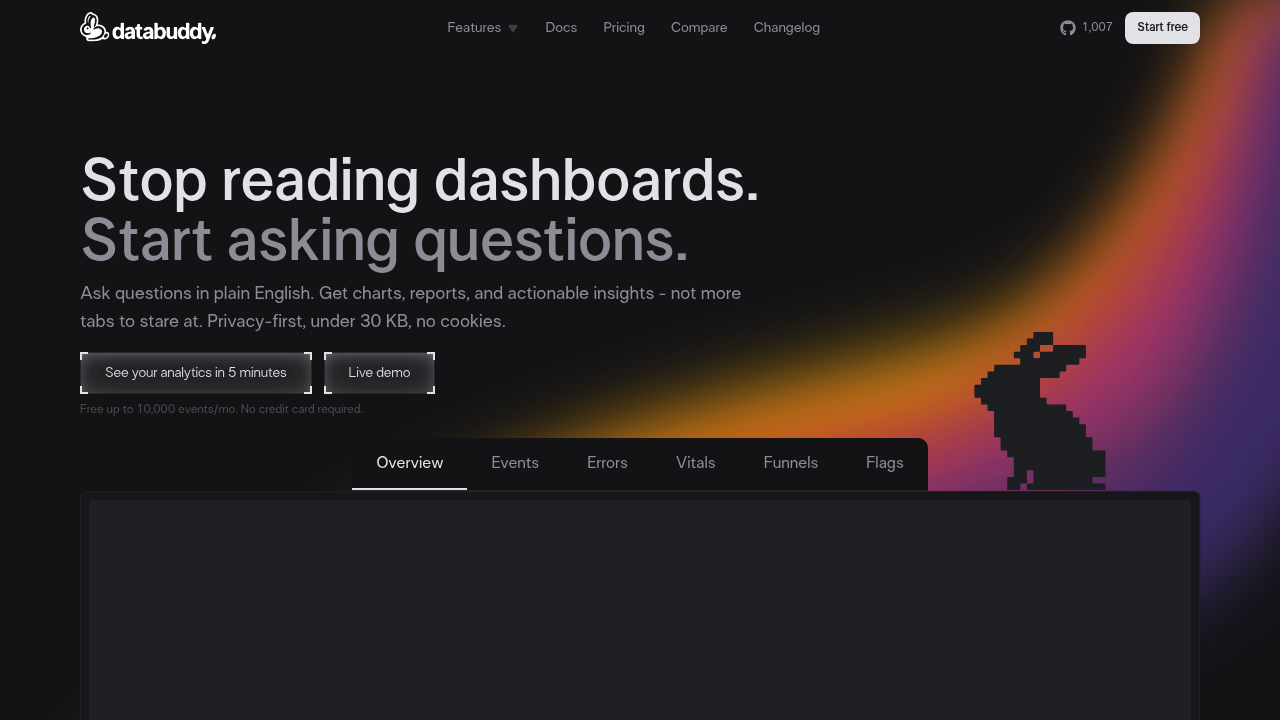
Databuddy is a privacy-first analytics platform built specifically for developers. The tracking script weighs under 30 KB, installs as a single async tag, and fires zero cookies by design — not as a configuration option, but as the default architecture.
Custom event tracking is native. You can emit arbitrary named events from client-side JavaScript, React/Next.js hooks, or the Node SDK, and they show up in the real-time dashboard immediately. The Event Tracking API accepts structured payloads, so you can attach properties (plan type, button label, page section) to each event without storing any PII.
What sets Databuddy apart from most of the platforms on this list is the AI query layer, called Databunny. Instead of manually building funnels or pivot tables, you can ask "Which CTA had the highest click rate last week for users on mobile?" in plain English and get a chart back. For teams that need conversion funnel tracking without a consent management layer, this is one of the most developer-friendly options available.
The platform also integrates error tracking, Core Web Vitals monitoring, and feature flag management into the same script — no additional third-party payloads required. GDPR and CCPA compliance are baked in; no consent banner is needed because no personal data is processed in the first place.
Custom event implementation (React):
import { track } from '@databuddy/sdk';

// Fire a custom event with properties
track('checkout_started', {
  plan: 'pro',
  source: 'pricing_page'
});
Pricing: Free up to 10,000 events/month. Paid tiers scale by volume.
2. Plausible Analytics
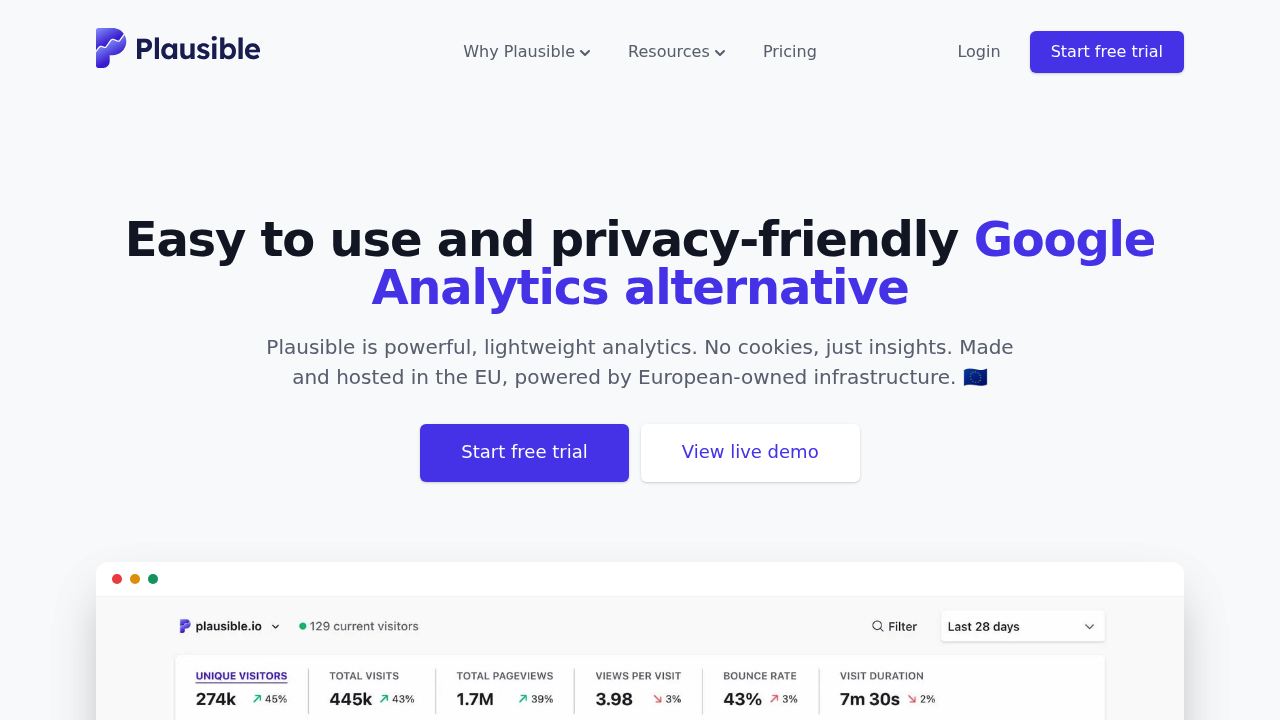
Plausible is an open-source, EU-hosted analytics tool that has been fully cookieless since its launch. The data policy is explicit: no cookies, no persistent identifiers, no personal data. The tracking script weighs under 1 KB.
Custom events in Plausible work via two mechanisms updated in October 2025. The no-code path uses CSS classes: add class="plausible-event-name=Signup" to any HTML element and Plausible tracks clicks on it automatically. The JavaScript path calls plausible('EventName', {props: {key: 'value'}}) for more granular control. The October 2025 script update also introduced automatic form submission tracking as a toggle — no manual instrumentation required for standard HTML forms.
The dashboard is intentionally minimal. You see event counts, top referrers, and conversion rates, but you won't find session replay, user-level paths, or funnel visualization beyond basic goal tracking. If your event tracking requirements are straightforward and your priority is absolute simplicity, Plausible is hard to beat.
One constraint worth noting: goals must be configured in the dashboard before data appears. There's no retroactive data population.
Custom event implementation:
// JavaScript method
plausible('Button Clicked', {props: {variant: 'hero-cta'}});

// CSS class method (no JS required)
// <button class="plausible-event-name=Hero+CTA">Get Started</button>
Pricing: Starts at $9/month (billed annually) for up to 10,000 monthly pageviews.
3. Matomo
Matomo is the most feature-complete open-source analytics platform available and one of the few that can genuinely replace Google Analytics feature-for-feature. In cookieless mode, it uses a method called config_id — a non-fingerprinting, privacy-safe identifier — to track anonymous visitors without setting any cookies.
Enabling cookieless mode requires a single line added before trackPageView:
_paq.push(['disableCookies']);
Custom event tracking uses the trackEvent method with a category/action/name/value structure:
_paq.push(['trackEvent', 'Video', 'Play', 'Product Demo', 1]);
Matomo supports custom dimensions, ecommerce tracking, A/B testing, heatmaps, and session recordings — all available in cookieless mode when properly configured. For teams that need the full behavioral analytics stack without relying on Google's infrastructure, Matomo self-hosted on EU servers is a serious option. The European Commission runs it on their own servers for a reason.
The trade-off is operational overhead. Self-hosting means you own the server, the database, and the update cycle. Matomo Cloud removes that burden but costs considerably more than lighter alternatives.
Pricing: Self-hosted is free (open source). Cloud starts at approximately $19/month.
4. PostHog
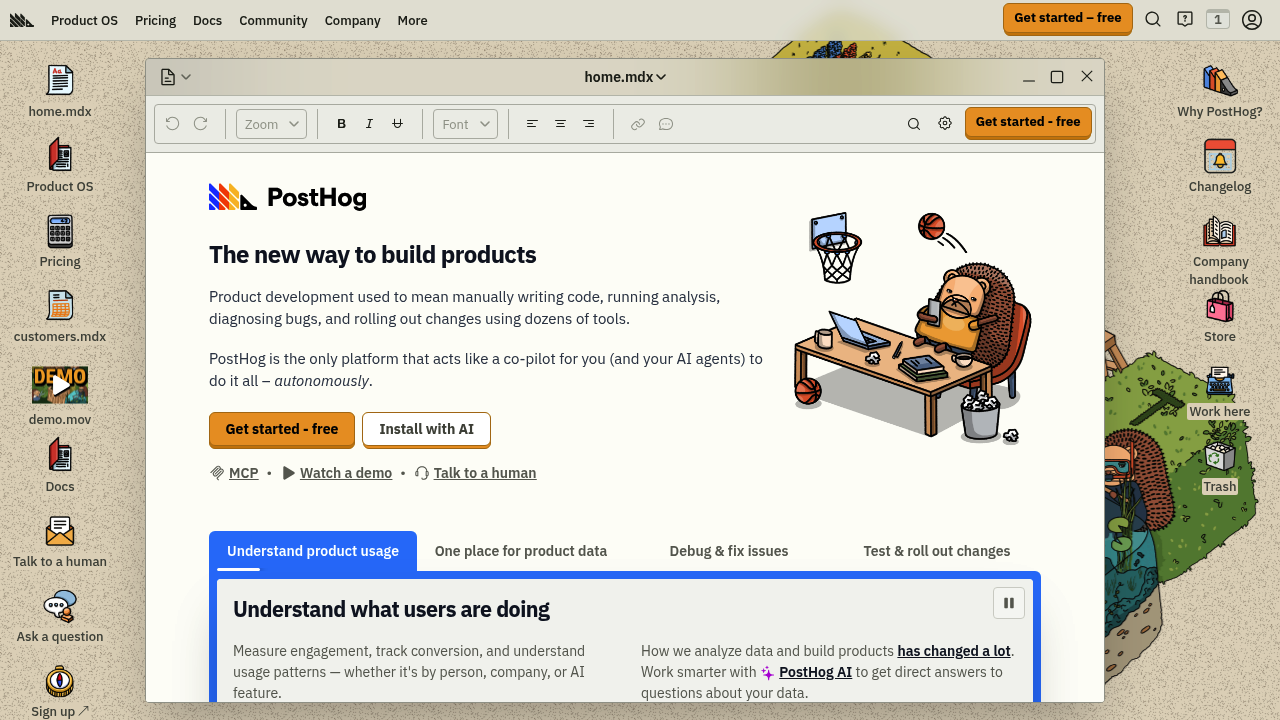
PostHog is an open-source product analytics platform that combines event tracking, session replay, feature flags, A/B testing, and a data warehouse. Cookieless tracking is available but requires explicit opt-in — it's not the default configuration.
When cookieless mode is enabled, PostHog switches from cookie/localStorage persistence to in-memory storage. The consequence is that user identity doesn't persist across page loads or sessions, which disables identify() calls and cross-session user stitching. For pure event counting — tracking which buttons get clicked, which features get used, which funnels complete — this works fine. For building long-term user behavior profiles, you'll need either the cookie-based mode with a consent flow or a server-side implementation.
Custom events are emitted with posthog.capture():
posthog.capture('feature_used', {
  feature_name: 'export_csv',
  plan: 'growth'
});
PostHog Cloud EU, hosted in Frankfurt, satisfies GDPR data residency requirements without self-hosting. For developer teams building SaaS products who want a full product analytics suite with real-time analytics and the ability to self-host for maximum control, PostHog is one of the most capable options on this list.
Pricing: Free tier covers 1 million events/month. Paid tiers are usage-based.
5. Umami
Umami is a lightweight, open-source analytics tool that is cookieless and GDPR-compliant by default. Like Plausible, it was designed from the start to avoid storing any personal data, which means no consent banner is required under GDPR or the ePrivacy Directive.
Custom event tracking in Umami uses the umami.track() function:
umami.track('signup_completed', {
  plan: 'enterprise',
  source: 'blog'
});
You can also use HTML data attributes for no-JS tracking:
<button data-umami-event="CTA Clicked" data-umami-event-plan="pro">
  Start Trial
</button>
Umami's dashboard is clean and fast. Events appear in a dedicated "Events" tab with breakdown by property, and funnel views are available in Umami Cloud. The self-hosted version requires a PostgreSQL or MySQL database and a Node.js runtime — straightforward for most engineering teams.
The main gap compared to Databuddy or PostHog is the absence of AI-assisted querying, error tracking, and feature flags. It's analytics in the classical sense: what happened, how often, from where. If that's what you need, Umami delivers it with minimal complexity and zero privacy compromise.
Pricing: Self-hosted is free. Umami Cloud starts at $9/month.
How these platforms compare on custom event tracking
| Platform | Cookieless by default | Custom events | Event properties | Funnels | Self-hostable |
|---|---|---|---|---|---|
| Databuddy | Yes | Yes | Yes | Yes | Yes |
| Plausible | Yes | Yes | Yes | Basic goals | Yes |
| Matomo | Optional (config) | Yes | Yes (custom dims) | Yes | Yes |
| PostHog | Optional (config) | Yes | Yes | Yes | Yes |
| Umami | Yes | Yes | Yes | Cloud only | Yes |
All five support server-side or API-based event ingestion, which means you can bypass client-side tracking entirely if your architecture calls for it — a useful option for SPAs with complex state management or applications where ad blocker interference is a concern.
What to think about before choosing
The decision isn't just about privacy posture. A few practical questions narrow the field quickly:
How much behavioral depth do you need? If you're tracking simple conversion events (form submit, signup, purchase), Plausible or Umami cover you without unnecessary complexity. If you need user-level paths, retention cohorts, or session replay alongside events, PostHog or Matomo are better fits — with the understanding that cookieless mode limits some user-stitching capabilities.
Do you want to own your data? All five support self-hosting. Matomo, PostHog, and Umami are fully open source. Plausible is open source but the hosted product is the primary commercial offering. Databuddy offers full data ownership with a transparent data policy.
What's your compliance jurisdiction? If you're operating under GDPR and concerned about cross-border data transfers, check where each vendor's cloud infrastructure is located. Plausible and PostHog Cloud EU are both EU-hosted. For a deeper look at how GDPR-compliant analytics tools compare to standard platforms, the differences go well beyond just cookie handling.
What does your dev team want? SDK quality matters. Databuddy and PostHog both have typed SDKs for React, Next.js, Node, and SvelteKit. Plausible and Umami have minimal SDKs that work but don't offer the same DX for complex instrumentation.
The broader shift toward cookieless analytics isn't just about regulatory risk management — it also produces more accurate data. When you're not dependent on consent rates, you see your actual traffic. No dark patterns, no consent fatigue, no silent data gaps where opted-out visitors used to be.
Any of the five platforms above will get you there. The right one depends on how much instrumentation complexity you need and how much infrastructure you want to own.