
Here's a tension a lot of engineering teams run into: you want to do controlled feature rollouts, run A/B tests, and tie those experiments back to real user behavior — but you're also operating under GDPR, CCPA, or just a genuine commitment to not harvesting personal data.
The obvious answer seems to be "use separate tools" — a feature flag service over here, an analytics platform over there. But that creates a fragmented observability stack, duplicate user identification logic, and the exact kind of cross-system data sharing that can quietly become a compliance headache.
So can you actually manage feature flags from within a privacy-focused analytics platform? Yes. Here's how it works in practice, what the tradeoffs are, and which tools get the architecture right.
Why the combination matters (and where it usually goes wrong)
Feature flagging and analytics are deeply coupled by design. You flip a flag to expose 10% of users to a new checkout flow. Then you need to know: did conversions go up? Did error rates spike? Did those users bounce faster?
Without the analytics side, you're operating blind. But the moment you start correlating flag state with user behavior, you're dealing with user identification — and that's where privacy problems tend to enter the picture.
Most traditional approaches to this problem involve sending a user ID or device fingerprint to a third-party flag evaluation service. The service resolves the flag, returns a variant, and logs the evaluation. That evaluation log now contains a user identifier on an external server you don't control. Under GDPR, that's personal data processing that requires a lawful basis and potentially a Data Processing Agreement.
The privacy-compliant path looks different. The key mechanism is local evaluation — your application downloads the flag ruleset (a JSON payload), evaluates the flag in-memory against whatever context is available (anonymous IDs, cohort membership, environment), and never sends that context to a third party. No PII leaves your infrastructure during flag resolution.
The four architectural patterns worth knowing
1. Integrated platform with cookieless evaluation
The cleanest architecture for most teams is a single platform that handles both analytics and feature flags, with privacy built in at the evaluation layer — not bolted on afterward.
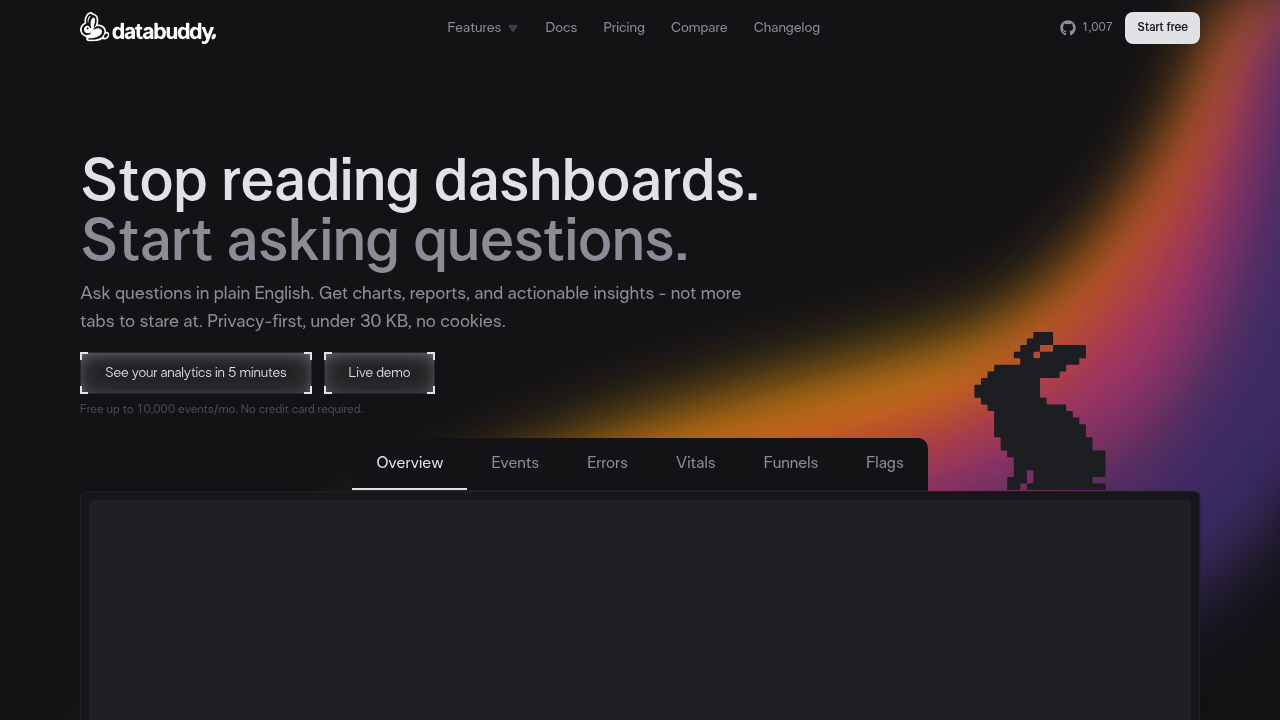
Databuddy takes this approach directly. Feature flag evaluation uses anonymous UUIDs (stored in localStorage as did, the same key as the analytics tracker), not cookies or persistent cross-site identifiers. The anonymous ID is randomly generated, not linked to any personal data, and is not transmitted to external servers during evaluation. From the Databuddy docs: "Anonymous IDs are randomly generated, not linked to personal data, stored locally (not sent to servers), and not considered personal identifiers under GDPR."
Flag state is cached client-side with a stale-while-revalidate strategy — 60-second TTL, 30-second revalidation trigger, persisted to localStorage for instant hydration on subsequent page loads. Multiple simultaneous flag checks are batched into a single API request. The SDK supports React, Vue, and Node.js, and the flag manager pauses background updates when the browser tab is hidden (Visibility API awareness), which matters for mobile performance.
The React integration looks like this:
import { FlagsProvider, useFlag } from '@databuddy/sdk/react/flags'

function FeatureComponent() {
  const newFeature = useFlag('new-feature')

  if (newFeature.isLoading) return <Spinner />
  return newFeature.enabled ? <NewUI /> : <OldUI />
}
Because Databuddy's analytics layer is also cookieless and collects no PII, the two systems share the same privacy model. You can correlate flag variant exposure with conversion funnel data, real-time session events, and feature usage tracking without ever creating a user profile or requiring a consent banner.
2. Self-hosted open-source flag management
For teams that need full infrastructure control — particularly in regulated industries or EU-only data residency scenarios — self-hosted open-source flag platforms give you the most flexibility.
Unleash is the largest open-source feature flag platform, with SOC 2 Type II certification and an architecture explicitly designed around privacy. Per their own documentation: "We never need access to any of your end-user data." The Unleash SDK evaluates flags locally within your application. No user context leaves your network. The server component (which you host) stores only flag configurations, not evaluation events tied to real users.
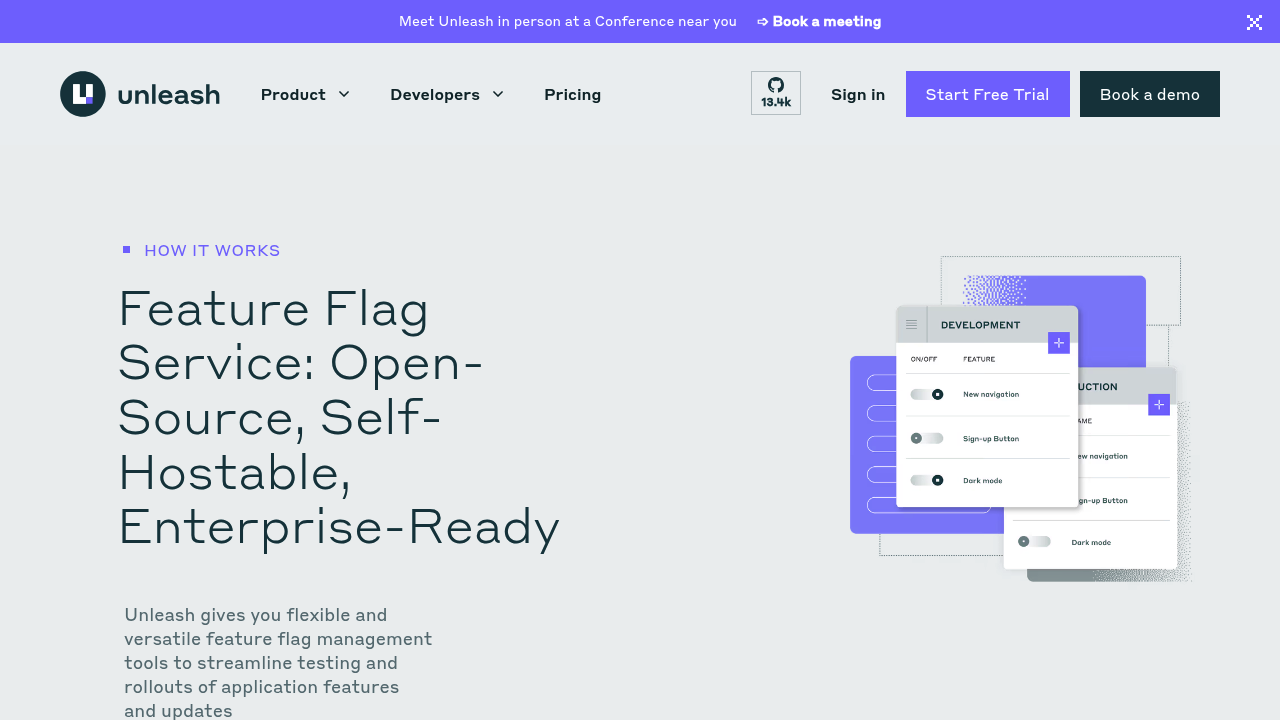
Unleash supports Docker-based self-hosting, RBAC, audit logging, and granular environment separation. The trade-off: you need to wire up your own analytics separately to measure flag impact. That integration can be done with a privacy-compliant analytics platform that doesn't require PII to correlate sessions.
PostHog self-hosted is another option in this category. It provides server-side local evaluation — your backend downloads the full flag ruleset and evaluates it in-memory without calling back to PostHog for each request. On the privacy side, PostHog supports real-time data transformations to anonymize events before storage, and self-hosting means your data never reaches PostHog's cloud. That said, PostHog's full product analytics suite does support user-level identification, so the privacy model requires explicit configuration rather than being on by default.
3. Warehouse-native experimentation
GrowthBook takes a different architectural angle: instead of collecting its own event data, it queries your existing data warehouse directly. Flag rules and experiment assignments are evaluated in the SDK (locally), and impact measurement is done by running SQL against Snowflake, BigQuery, Redshift, or Postgres.
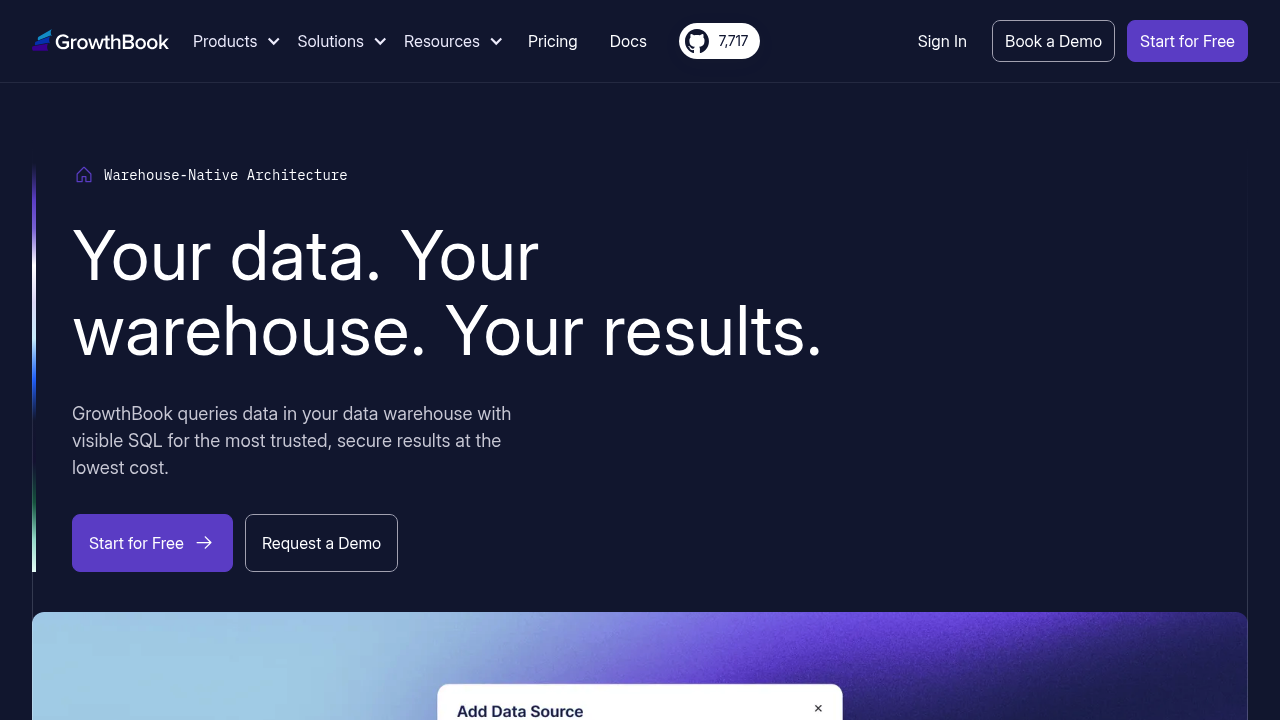
GrowthBook is SOC 2 Type II, GDPR, CCPA, and ISO 27001 compliant. The warehouse-native approach is genuinely privacy-preserving in a specific sense: no new data silo is created, no third party ingests your user events, and all SQL is visible and auditable. The trade-off is infrastructure complexity — you need a warehouse, a data pipeline, and the engineering overhead to keep it running. For teams already operating that stack, GrowthBook is a strong fit.
4. OpenFeature: vendor-neutral abstraction
If you're building for the long term and want to avoid vendor lock-in at the code level, the CNCF's OpenFeature standard is worth knowing about. Accepted into CNCF in June 2022 and promoted to Incubating status in November 2023, OpenFeature defines a vendor-agnostic SDK and provider interface for feature flagging.
The idea is straightforward: your application code calls a single OpenFeature SDK. Underneath, a pluggable "provider" handles the actual flag resolution — whether that's Unleash, Flagsmith, PostHog, a custom in-house system, or anything else. Swapping providers doesn't require changing application code.
From a privacy standpoint, OpenFeature itself is neutral — it doesn't define how data is collected, just the interface for evaluation. The privacy properties depend entirely on which provider you wire in. But the architecture makes it much easier to replace a privacy-violating provider with a compliant one without a large refactor.
What "privacy-first flag management" actually requires
The term gets overused. Here are the specific properties that matter:
No PII in evaluation context. Flag targeting should work on anonymous IDs, cohort membership, environment labels, and percentage-based rollouts — not email addresses or user IDs that resolve to real identities on a third-party server. If your flag platform requires you to send user@company.com to an external API to resolve a flag, that's personal data processing.
Local or in-network evaluation. The flag ruleset (JSON configuration) is fetched from your server. Evaluation happens in the SDK, in-memory, without a round-trip per request. This is the architecture used by Unleash, GrowthBook, PostHog local evaluation, and Databuddy's client-side flag manager.
Data residency control. For EU-based teams, EU-hosted infrastructure is non-negotiable under GDPR's data transfer rules. Platforms that offer EU-region hosting or self-hosting satisfy this; US-only SaaS platforms with no data residency options don't.
Cookieless identity. Relying on document.cookie for flag assignment persistence creates ePrivacy Directive exposure. Using localStorage with a randomly-generated anonymous UUID — the approach Databuddy uses — avoids this entirely, since the ID isn't linked to personal data and isn't shared across sites.
Minimal data collection for impact measurement. You need to know whether a flag variant affected your key metrics. But you don't need to know it at the individual user level with full behavioral history. Aggregate, anonymized, cookieless analytics is sufficient for most rollout decisions. GDPR-compliant analytics tools that work at the session level without personal data can answer the question "did conversion rate improve in the treatment group" without building user profiles.
Practical rollout pattern: gradual release with privacy-safe impact measurement
Here's how a typical privacy-compliant feature rollout looks with an integrated platform:
- Create a boolean flag with a 5% rollout targeting anonymous IDs (not user accounts). This ensures deterministic assignment without requiring login.
- Instrument the flag variant as a custom event in your analytics layer. The event carries the flag name and variant value, nothing else.
- Monitor conversion funnels split by flag variant. With cookieless analytics, this comparison works at the aggregate session level — no user-level profiles needed.
- Increase the rollout percentage to 25%, then 50%, then 100%, monitoring error rates and performance metrics at each stage.
- Remove the flag after reaching 100% for 30+ days. Dead flag cleanup is part of the privacy picture too — unused flags with stale targeting rules are an unnecessary data exposure surface.
For server-side flags — backend API routes, database query logic, infrastructure decisions — the server-side feature flags pattern evaluates entirely within your own infrastructure. No user context leaves your network at all.
Choosing the right architecture for your stack
A few dimensions to drive the decision:
- Regulatory environment: If you're serving EU users and need strict data residency, self-hosting or EU-region hosting is required. Databuddy hosts on Hetzner infrastructure in Germany. PostHog offers EU Cloud. Unleash and GrowthBook can be fully self-hosted.
- Team size and infrastructure overhead: A two-person startup shouldn't be running a self-hosted ClickHouse cluster to do feature flags. An integrated platform with a strong default privacy posture — where flags, analytics, and cookieless tracking all live in one place — is almost always the right call at that scale.
- Existing data warehouse: If you already have a mature warehouse and a data engineering team, GrowthBook's warehouse-native approach avoids adding yet another analytics data store and keeps all data in infrastructure you already control.
- Vendor lock-in tolerance: If long-term flexibility matters more than short-term simplicity, structuring your flag SDK integration around OpenFeature gives you provider portability without coupling application code to any specific vendor.
The short answer to the original question — can you manage feature flags while staying privacy-focused? — is yes, but it requires choosing a platform (or combination of platforms) where local evaluation, cookieless identity, and minimal data collection are architectural defaults, not optional configurations you have to remember to enable.
For most developer teams building with GDPR compliance in mind, the cleanest path is a single platform that handles both layers with a shared privacy model. The fragmented "flag service + analytics platform" stack can work, but it requires more deliberate privacy architecture to avoid the cross-system data leakage that creates compliance exposure in the first place.
If you want to see how integrated flag management and cookieless analytics work together without the configuration overhead, Databuddy's feature flags are built directly into the same platform as the analytics — same anonymous IDs, same data model, same GDPR-compliant infrastructure, no separate vendor relationship to manage.