
Here's something most teams don't realize until it stings: your analytics dashboard might be showing you 40% of your actual traffic. Not because your tool is broken, but because 60% of your European visitors rejected the cookie banner, and that data simply vanished.
According to etracker's 2025 Cookie Consent Benchmark Study, a legally compliant GDPR banner with a clearly visible "Reject All" button results in an average 60% loss of visit data. CookieYes's 2025 Global Compliance Guide put it even more starkly: fewer than 25% of users in Germany and France actively accept tracking cookies. You're making product and marketing decisions on a heavily filtered slice of reality.
This is one of the most concrete, practical differences between GDPR-compliant analytics tools and standard ones in 2026 — and it's just the starting point.
What "GDPR-compliant analytics" actually means
The phrase gets thrown around loosely, so let's anchor it to specifics. A genuinely GDPR-compliant analytics tool has to meet several non-negotiable criteria:
- No persistent identifiers across sessions unless the user explicitly consents
- No personal data collection — IP addresses, device fingerprints, user IDs — without a lawful basis
- Data minimization as a design principle, not an afterthought
- EU data residency or a valid cross-border transfer mechanism (and even then, the legal risk doesn't disappear)
- Full data ownership — you should be able to export, delete, or migrate your data at will
Standard analytics tools — GA4, Adobe Analytics, Amplitude in default configuration — were built before the current regulatory environment existed. Their architecture assumes broad data collection and US-based cloud processing. Compliance is layered on top through Consent Mode, IP anonymization toggles, and data processing agreements. The foundation was never privacy-first.
The Google Analytics 4 compliance situation in 2026
GA4 made real improvements: IP addresses are no longer logged or stored for EU users (confirmed in Google's own support documentation), and data regions allow European processing. Google is also a certified participant under the EU-U.S. Data Privacy Framework (DPF), which the European Commission adopted in July 2023.
That said, the legal picture remains genuinely uncertain. Five European DPAs — Austria, France, Italy, Denmark, and Norway — issued rulings between 2022 and 2023 declaring specific Google Analytics implementations unlawful under GDPR, primarily citing US intelligence law (FISA 702) giving American authorities theoretical access to data regardless of where it's stored. The EU-U.S. DPF was meant to resolve this, and on September 3, 2025, the EU General Court upheld the adequacy decision in the Latombe v. Commission case (T-553/23), dismissing a direct challenge to the framework. That's a significant ruling in GA4's favor.
But WilmerHale noted in December 2025 that the Court of Justice of the EU is now set to review a separate challenge to the DPF, meaning the legal foundation for US data transfers could still shift. The honest assessment: GA4 is currently more defensible than it was in 2022, but describing it as definitively GDPR-compliant remains a stretch. Compliance depends heavily on how it's configured, what supplementary measures are in place, and which EU member state's DPA you're dealing with.
If you're operating in Germany, France, Austria, or the Nordic countries and you haven't gotten specific legal advice on your GA4 setup, you're accepting real risk.
How the two approaches differ in practice
Data collection architecture
Standard analytics platforms collect first — then ask. They drop cookies, associate user IDs, and build behavioral profiles. Consent management is the gate between collection and legality. If that gate fails (and according to Secure Privacy, 67% of Consent Mode v2 setups fail to meet compliance standards), you're exposed.
Privacy-first tools like Databuddy, Plausible, Matomo in cookieless mode, and Fathom invert this. They're built on aggregated, anonymous data from the start. No cookies means no consent requirement under ePrivacy Directive Article 5(3). No personal data means GDPR's data minimization principle is satisfied structurally, not procedurally.
Databuddy, for instance, uses no cookies and no fingerprinting — it never touches personal data in the first place. The GDPR compliance guide documents exactly how this works at the technical level, which matters if you ever need to demonstrate compliance to a regulator or a due-diligence team.
Data accuracy and completeness
This is where the operational cost of standard analytics becomes impossible to ignore. With a compliant cookie banner, you're measuring a biased sample. Users who decline tracking often behave differently from those who accept — they tend to be more privacy-aware, often more technical, potentially your most valuable audience.
Cookieless analytics captures everyone. Your data reflects actual traffic patterns rather than the self-selected 40% willing to be tracked. For product decisions, funnel analysis, and content performance, this isn't a minor consideration.
Page performance impact
GA4's gtag.js tracking script runs around 45KB. That's not nothing on a mobile connection or a page where you're fighting for Core Web Vitals scores. Privacy-first tools are consistently lighter — Plausible runs under 1KB, and Databuddy's script is approximately 3KB. The performance difference is real, particularly on pages with multiple third-party scripts already loaded.
Feature depth vs. compliance simplicity
GA4 does things that privacy-first tools don't. Its machine learning models predict churn, estimate revenue from non-consenting users via behavioral modeling, and integrate tightly with Google Ads for attribution. Adobe Analytics offers session stitching and multi-channel attribution at enterprise scale that's genuinely difficult to replicate without cookies.
The tradeoff is complexity and compliance overhead. Running GA4 properly in the EU requires a certified Consent Management Platform (since Google's March 2024 enforcement deadline), correct Consent Mode v2 implementation, regular auditing of data processing agreements, and ongoing monitoring of DPA decisions across every EU market you operate in. That's real engineering and legal time.
Privacy-compliant tools skip most of that. What you lose in predictive modeling and ad attribution, you gain in operational simplicity and clean legal standing.
The main GDPR-compliant analytics tools compared
Plausible Analytics
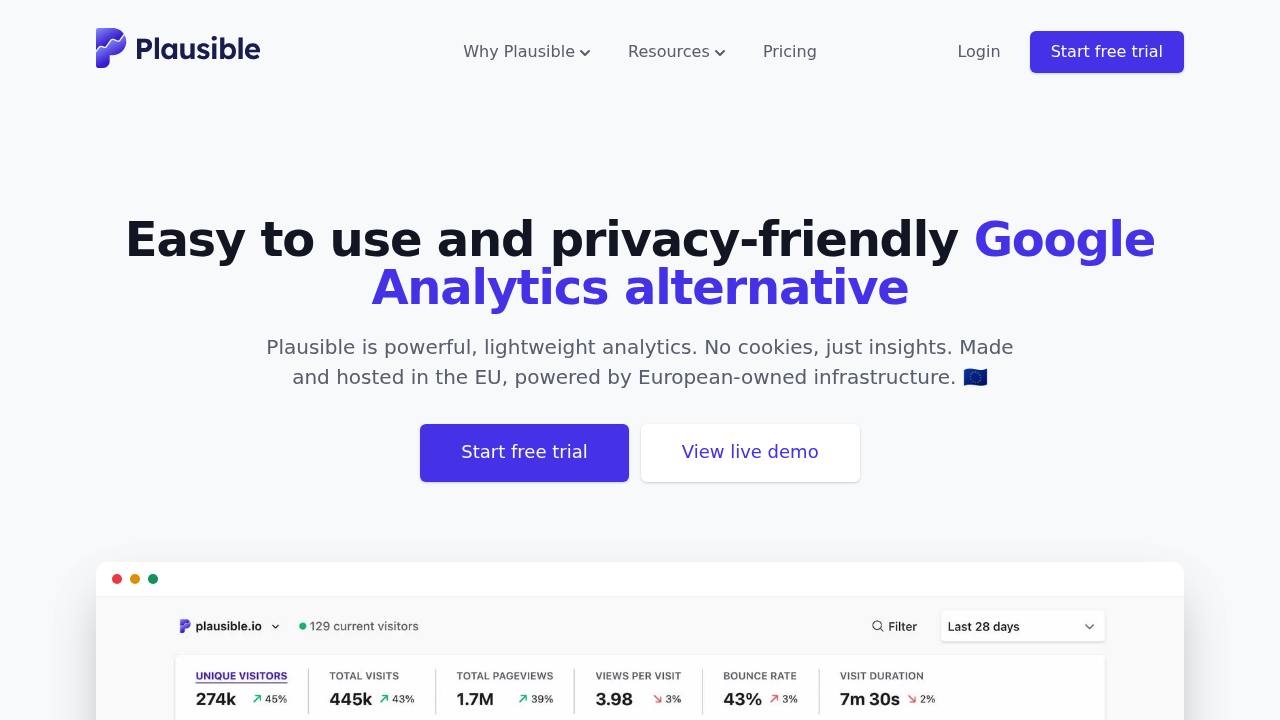
Plausible is the go-to choice for teams that want clean traffic data without any setup friction. It's open source, hosted in the EU, and processes no personal data. The dashboard is intentionally simple — you get pageviews, sessions, referrers, device data, and goals. No sampling, no modeling, no data retention games. Pricing starts around $9/month for up to 10K pageviews. The tradeoff is that it doesn't do funnels, user-level analysis, or session recordings. It's a great fit for content sites and straightforward SaaS products. For cookieless analytics without consent forms, Plausible is a reliable answer.
Matomo
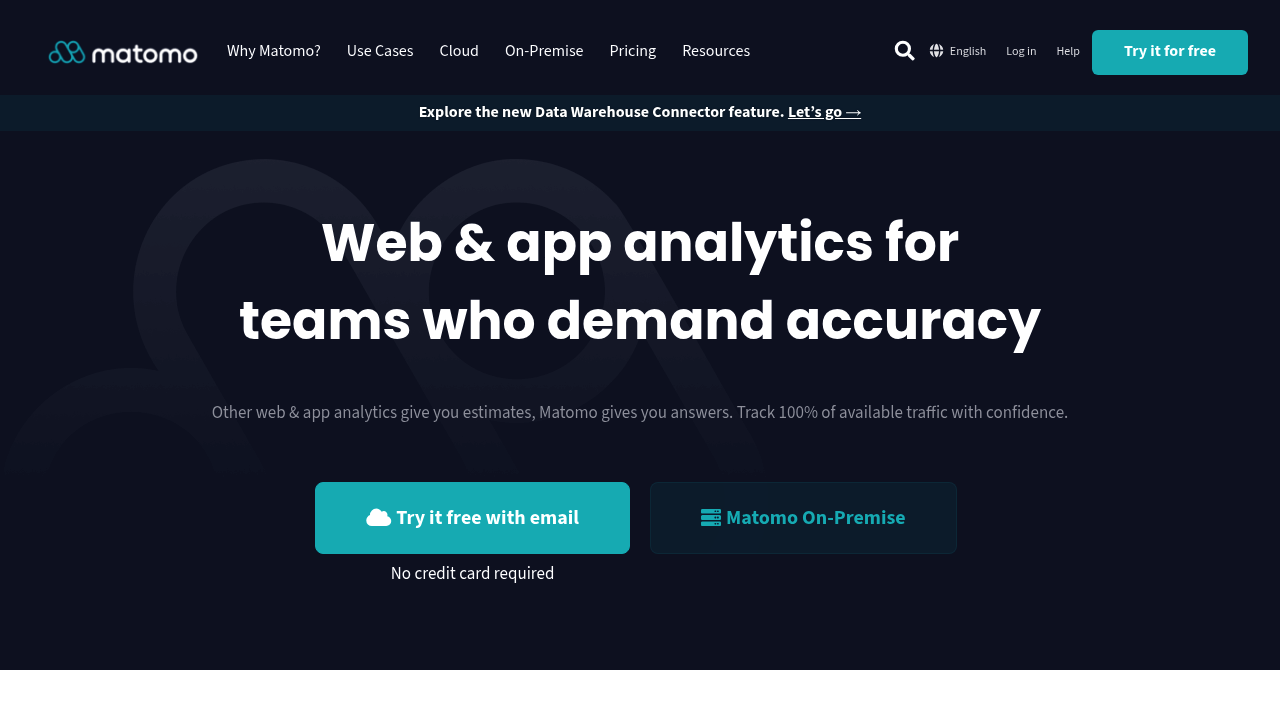
Matomo is the most feature-rich privacy-first option available. Self-hosted, it gives you complete data ownership and the full feature set: heatmaps, session recordings, A/B testing, funnel analysis, and a built-in GDPR Manager for handling data subject requests. When configured correctly with cookieless tracking and appropriate data retention limits (13 months for France's CNIL requirements, for instance), Matomo can qualify for audience measurement exemptions in several EU jurisdictions. The cloud version hosts your data in the EU. The self-hosted version requires DevOps investment, but for organizations that need every feature GA4 offers without the compliance headaches, Matomo is the most direct substitute. See the Databuddy vs Matomo comparison for a detailed breakdown of how the platforms differ.
Piwik PRO
Piwik PRO occupies the enterprise end of the privacy-compliant market. It combines a full analytics suite with a built-in Consent Management Platform, a Tag Manager, and a Customer Data Platform. EU cloud hosting, ISO 27001 certification, and SOC 2 compliance make it the right choice for healthcare, finance, and government organizations where the compliance bar is highest. The pricing reflects that positioning — it's significantly more expensive than Plausible or Databuddy, but for teams with complex consent workflows and cross-property tracking needs, it covers ground no other tool does.
Databuddy

Databuddy sits at the intersection of privacy compliance and product analytics depth. It's 100% cookieless by design — no consent banners required — and is GDPR and CCPA compliant by default. Where it differentiates from simpler tools like Plausible is the feature set: real-time session monitoring, conversion funnel analysis, error tracking, feature flag management, and an energy-efficient infrastructure. Full data ownership means your data stays yours, and there's no third-party data sharing or profiling happening in the background.
For developers building modern web applications who need more than a traffic counter but can't justify the compliance overhead of GA4, Databuddy threads that needle well. The best real-time analytics tools for developers that don't use cookies guide covers how it compares technically. A free tier covers up to 10K pageviews, which makes it genuinely accessible for early-stage teams.
The hidden cost of cookie-based analytics
There's a calculation that rarely makes it into vendor comparisons. If your site gets 100,000 monthly visitors in Europe and 60% reject your analytics cookies, you're making decisions based on 40,000 data points instead of 100,000. At a 1.5% visitor-to-paid conversion rate and $110 revenue per conversion, that's meaningful unattributed revenue disappearing into your consent banner every month.
Databuddy's cookie banner cost calculator lets you run this math against your own numbers. For most teams that have done it, the result shifts the question from "why would we switch?" to "why haven't we switched already?"
Ad blockers compound this. Studies consistently show that uBlock Origin, Privacy Badger, and similar extensions block GA4 at rates between 25-40% depending on the user demographic. Technical audiences — developers, security researchers, privacy-conscious users — block tracking at much higher rates. Privacy-first analytics tools, particularly self-hosted ones, are significantly less likely to be blocked because they don't match known tracker signatures.
Which type of tool belongs in your stack?
The honest answer depends on your specific situation:
Standard analytics (GA4, Adobe) makes sense when: - You run paid Google Ads campaigns and need tight attribution and conversion modeling - You have a dedicated compliance team that can maintain proper Consent Mode v2 configuration - You need BigQuery-level data exports for complex cross-channel analysis - Your legal team has assessed and accepted the residual DPF risk
GDPR-compliant analytics tools are the right choice when: - You operate primarily in EU markets and want to avoid regulatory exposure outright - You need accurate, unsampled data that isn't filtered through consent rates - Your team is small and consent management overhead is a real cost - You're building a product where user trust is a core value proposition — the absence of a cookie banner is itself a signal to users - You want full data ownership without third-party cookies
For many teams, the answer is a hybrid: a lightweight privacy-compliant tool as the primary analytics layer, with GA4 added back only if Google Ads campaigns make the attribution data genuinely necessary.
The regulatory direction is clear
The trajectory of EU data protection enforcement over the past four years has moved in one direction. DPAs have issued decisions against analytics tools in Austria, France, Italy, Denmark, and Norway. CNIL has updated its guidance on audience measurement exemptions. Germany's TDDDG tightened requirements for cookie consent. Piano.io's January 2026 analysis of European privacy fines confirmed that consent violations remain the single most common enforcement category across all years tracked.
The DPF provides breathing room for US data transfers right now, but the CJEU challenge to the framework means that room could narrow. Organizations that have built their analytics stack on privacy-compliant tools aren't waiting to find out — they've already de-risked the question.
For developers and technical teams specifically, the analytics tools for regions with strict data privacy laws comparison is worth reading before making stack decisions this year. The tools have matured to the point where privacy compliance no longer means accepting materially worse data — in most cases, you get better data, with less legal exposure, and faster page loads.
That's not a minor upgrade. That's the point.