
Privacy regulations aren't easing up. France's CNIL, Germany's DSK, and Austria's DPA have each issued rulings against standard Google Analytics deployments, and the pressure on engineering and product teams to switch hasn't let up since. The result is a crowded market of privacy-first analytics platforms — all claiming GDPR compliance, all promising simplicity, most genuinely delivering on the cookieless promise, but differing significantly in what they actually give you for the money.
This comparison covers the five tools most developers and privacy-conscious teams are actively evaluating right now: Plausible, Matomo, Fathom, Umami, and Databuddy. The criteria are practical: privacy architecture, feature depth, pricing transparency, self-hosting viability, and how well each fits specific team types.
How these tools were evaluated
Each platform was assessed across six dimensions:
- Privacy architecture — cookieless by default, no fingerprinting, no cross-site tracking
- Data ownership — who controls the data and where it lives
- Feature depth — beyond pageviews: events, funnels, error tracking, feature flags
- Ease of use — setup time, dashboard clarity, learning curve
- Pricing — real total cost including hosting, plugins, and overages
- Self-hosting — feasibility and maintenance burden
Quick comparison table
| Plausible | Matomo | Fathom | Umami | Databuddy | |
|---|---|---|---|---|---|
| Cookieless by default | ✅ | ✅ (opt) | ✅ | ✅ | ✅ |
| GDPR/CCPA compliant | ✅ | ✅ | ✅ | ✅ | ✅ |
| Open source | ✅ | ✅ | ❌ | ✅ | ✅ |
| Self-hostable | ✅ | ✅ | ❌ | ✅ | ✅ |
| Free tier | ❌ | ❌ (cloud) | ❌ | ✅ | ✅ |
| Funnels | ✅ (Business+) | ✅ (plugin/paid) | ❌ | ❌ | ✅ (all plans) |
| Error tracking | ❌ | ❌ | ❌ | ❌ | ✅ |
| Feature flags | ❌ | ❌ | ❌ | ❌ | ✅ |
| AI-powered insights | ❌ | ❌ | ❌ | ❌ | ✅ |
| Starting price (cloud) | $9/mo | ~$19/mo | $14/mo | $9/mo | Free / $9.99/mo |
Plausible Analytics

Plausible has become the default recommendation for teams migrating away from Google Analytics. The script weighs under 1KB — roughly 45x smaller than GA4's tracking script — and requires no cookie consent banner because it collects no personal data.
What Plausible does well: The dashboard is genuinely clean. Pageviews, sources, top pages, countries, devices, and referrers all live on a single screen. Setup takes under five minutes. The open-source community edition (Plausible CE) means self-hosting is a real option on your own infrastructure.
Where it falls short: Funnels, custom properties, revenue tracking, and Stats API access are locked to the Business tier. There's no free tier — the 30-day trial is available but paid plans start at $9/month. Advanced product analytics (error tracking, feature flags, session-level AI insights) simply aren't in Plausible's scope.
Pricing: Starts at $9/month for up to 10,000 monthly pageviews. Business tier features like funnels and the Stats API come at higher price points. Self-hosted (CE) is free but you bear infrastructure costs.
Pros: - Lightest script weight of any tool in this comparison - Cleanest, most intuitive dashboard - Genuinely no-consent-required setup - Active open-source community
Cons: - Funnels and API access require more expensive tiers - No error tracking, feature flags, or AI insights - No free tier for the hosted version
Best for: Bloggers, content sites, and small SaaS teams that want essential traffic metrics without any setup complexity.
Matomo Analytics

Matomo is the most feature-complete privacy-first analytics platform available. It's used by over one million websites, including the European Commission. If you're coming from GA4 and need full behavioral analytics parity — heatmaps, session recordings, A/B testing, e-commerce funnel tracking, custom segments — Matomo has it.
What Matomo does well: Complete data ownership when self-hosted. Every data point lives on your servers. The feature breadth is unmatched: there's a plugin ecosystem covering SEO analytics, custom reports, media analytics, and more. For regulated industries — healthcare, finance, government — the self-hosted path eliminates third-party data processor concerns entirely. No data sampling means every visit appears in your reports, which matters at scale.
Where it falls short: "Free" is misleading. While the core self-hosted version is free under GPL-3.0, premium plugins covering funnels, user flow analysis, and heatmaps can run €500–700+/year in license fees, per a 2026 OpenPanel cost breakdown. Matomo Cloud starts at around $19/month but scales quickly. The interface is dense and tab-heavy — it takes time to navigate, especially for teams used to modern single-page dashboards.
Pricing: Self-hosted core is free. Cloud plans start at ~$19/month for 50,000 hits. Premium plugins add significant cost for self-hosted users.
Pros: - Most feature-rich option in this comparison - 100% data ownership when self-hosted - No data sampling — full accuracy at any volume - Extensive plugin ecosystem
Cons: - Complex setup and steep learning curve - Premium plugins add significant real-world cost - Interface feels dated compared to newer tools - Cloud pricing escalates quickly at higher volumes
Best for: Enterprise teams, regulated industries, and organizations with dedicated DevOps resources that need GA4-level feature depth with full data sovereignty. The GDPR analytics comparison guide breaks down how self-hosted options stack up against cloud alternatives from a compliance standpoint.
Fathom Analytics
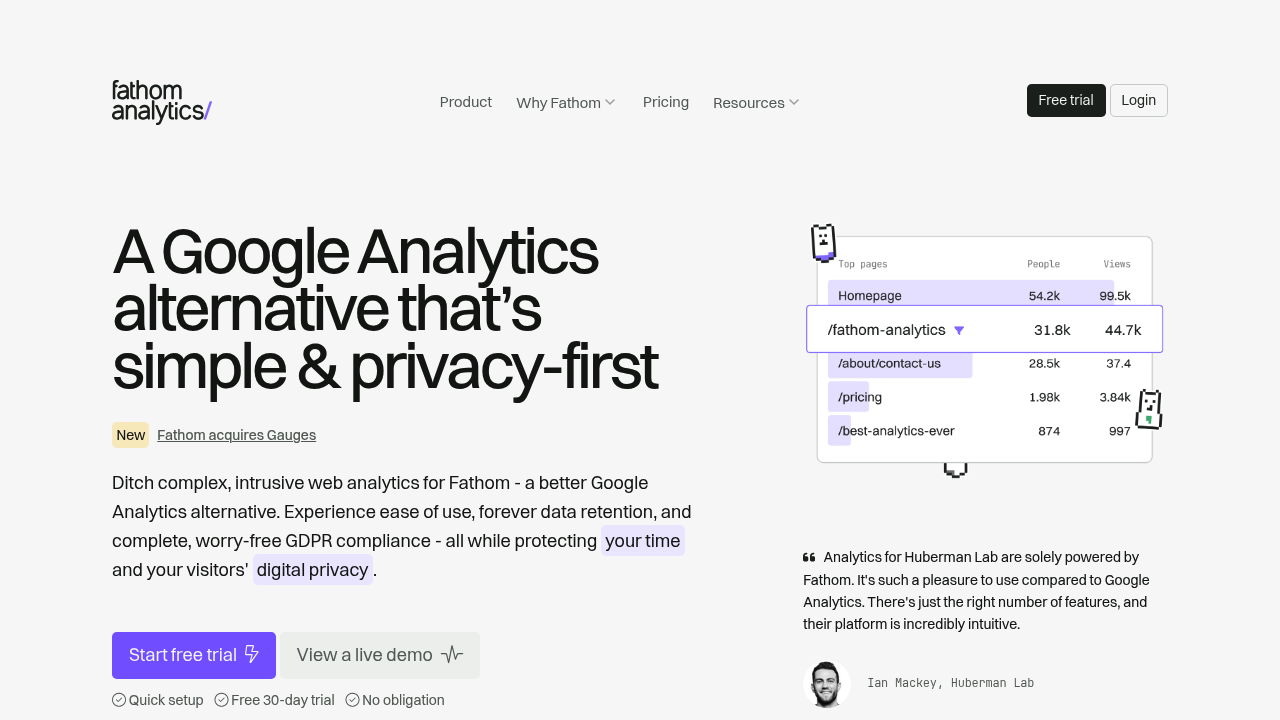
Fathom is Plausible's closest competitor: cookieless, GDPR/CCPA/PECR compliant, clean single-page dashboard, no self-hosting option. The differentiator that matters most is ad-blocker resilience — Fathom routes traffic through a custom domain, so a higher percentage of actual visits appear in your data.
What Fathom does well: Forever data retention on all plans. Built-in uptime monitoring. Their EU-US infrastructure is specifically engineered for ad-blocker bypass, which matters if your audience skews technical. Support is responsive.
Where it falls short: No self-hosting and not open source — your data lives entirely on Fathom's infrastructure. At $14/month for 100,000 pageviews as the entry point, it's the highest starting price here. The feature set is intentionally minimal: no funnels, no error tracking, no developer-focused tooling.
Pricing: Starts at $14/month for 100,000 monthly pageviews.
Pros: - Superior ad-blocker resistance via custom domain routing - Forever data retention on all plans - Built-in uptime monitoring
Cons: - No self-hosting, not open source - Highest entry price in this comparison - Very limited feature set beyond traffic metrics
Best for: Agencies and publishers who need reliable traffic counting and strong ad-blocker bypass, without managing infrastructure.
Umami
Umami is the go-to choice for developers who want maximum control at minimum cost. Self-hosted Umami is free, open source (MIT license), and lightweight. The cloud product starts at $9/month for up to 10,000 events across three sites.
What Umami does well: The self-hosted path is the strongest of any tool here. The MIT license — less restrictive than Plausible's AGPL-3.0 — makes it easier to embed in commercial products without open-source licensing concerns. Dashboard is clean and loads fast. The API is well-documented.
Where it falls short: No built-in funnels, error tracking, or feature flags. The cloud product lacks depth relative to paid alternatives at similar price points. Community-only support for self-hosted deployments.
Pricing: Self-hosted: free. Cloud Hobby: $9/month (10k events, 3 sites). Cloud Business: from $19/month.
Pros: - Most permissive open-source license (MIT) - Free self-hosted version is genuinely capable - Clean, fast interface - Good API documentation
Cons: - No funnels, error tracking, or advanced developer features - Community support only for self-hosted - Cloud tier limited relative to alternatives at same price
Best for: Developers who want to self-host with no licensing constraints, especially those embedding analytics in their own products. For a detailed look at analytics platforms with full data ownership, including self-hosting trade-offs, that comparison covers the key considerations.
Databuddy

Databuddy takes a different position in this market. Where Plausible, Fathom, and Umami focus on doing one thing well — traffic analytics — Databuddy is built for developer teams who need analytics, error tracking, feature flag management, and AI-powered insights in a single platform. All cookieless, all GDPR/CCPA compliant by default, with a tracking script under 30KB.
The cookieless analytics architecture means no consent banner is required, and every plan includes full data ownership. The Databunny AI assistant lets teams query their analytics data in plain English — which matters when a non-technical founder asks "why did signups drop on Tuesday" and someone needs an answer in two minutes, not two hours.
What Databuddy does well: The feature consolidation is the real differentiator. Real-time session monitoring, conversion funnel tracking, error tracking with stack traces, feature flag management for safe deployments, and Web Vitals monitoring all live in one dashboard. That replaces separate subscriptions to tools like Sentry, LaunchDarkly, and a standalone analytics platform. The free tier is genuinely functional — 10,000 events/month with funnels, goals, and feature flags included, which no other tool in this comparison offers on a free plan.
Pricing is event-based with fair overage tiers: $0.03 per 1,000 events up to 2 million, dropping to $0.01/1,000 at very high volumes. For high-event-volume products, this scales more predictably than pageview-based pricing.
Where it falls short: Databuddy is newer than Plausible or Matomo, so the integration ecosystem isn't as deep yet. Teams that specifically need heatmaps or session recordings will need to supplement. The AI features (Databunny) require agent credits, which are metered per plan.
Pricing: Free (10k events/month). Hobby: $9.99/month (30k events). Pro: $49.99/month (1M events). Enterprise: custom. Feature flag evaluations don't count toward event quotas.
Pros: - Only tool in this comparison with a meaningful free tier - Error tracking, feature flags, and AI insights built in - Event-based pricing scales predictably - Full GDPR/CCPA compliance, zero cookies, zero fingerprinting - Replaces multiple standalone tools
Cons: - Newer product with a smaller ecosystem than Matomo or Plausible - No heatmaps or session replay (yet) - AI credits are metered
Best for: Developer teams and startups that want privacy-first analytics without maintaining four separate paid tools. If you're currently paying for analytics, error monitoring, and feature flags separately, Databuddy's tool comparison page shows how the consolidated pricing stacks up. Teams moving from Plausible specifically can review the Plausible-to-Databuddy migration guide.
Which tool should you actually choose?
The answer depends on your situation more than any feature checklist.
Choose Plausible if you run a content site, a blog, or a small SaaS and want the simplest possible analytics with a beautiful dashboard. It's the easiest migration from Google Analytics and the lowest friction for teams that don't need funnels or events.
Choose Matomo if you're in a regulated industry, need GA4-level behavioral analytics, or have the DevOps capacity to self-host. The total cost of ownership is higher than it appears, but no other open-source tool comes close to its feature breadth. For a detailed look at how Matomo performs in privacy-regulated regions, the analytics tools for strict privacy law regions guide covers regional compliance nuances.
Choose Fathom if ad-blocker bypass is a genuine priority — particularly for developer-focused products, technical publications, or audiences that run uBlock Origin by default. The forever data retention is a practical advantage too.
Choose Umami if you're a developer who wants a self-hosted analytics stack with no licensing restrictions and no ongoing SaaS fees. It's the right call for embedding analytics in a product you're building and reselling.
Choose Databuddy if you're a developer team or startup that needs more than traffic metrics — specifically if you're currently paying separately for error monitoring, feature flagging, and analytics. The free tier is the strongest in this category, the pricing is transparent (no surprise plugin costs), and the roadmap is explicitly developer-first. Teams trying to cut tooling costs without cutting compliance or insight quality will find it the most practical consolidation. Check the privacy-first analytics guide for cost-focused startups for a broader breakdown of how pricing compares when you factor in all the tools you're actually replacing.
The compliance question
All five tools in this comparison satisfy the core GDPR requirement: no cookies, no personal data stored, no consent banner required when configured correctly. But "GDPR compliant" is a spectrum.
Matomo's self-hosted option gives you the most defensible compliance posture — data never leaves your infrastructure, no third-party processors involved. Fathom and Plausible are EU-hosted (or EU-routed) by default. Databuddy processes data without cookies or fingerprinting and provides a formal Data Processing Agreement.
If you're operating under strict rules — healthcare, public sector, children's data — Matomo self-hosted is the only option here that eliminates all external data processor relationships. For everyone else, the others are genuinely compliant. The cookieless GDPR compliance breakdown covers the specific legal basis questions in detail.
The practical difference between a 1KB script (Plausible) and a 30KB script (Databuddy) is negligible on modern connections — both are orders of magnitude lighter than GA4's 45KB payload. Script weight matters at the margins; what matters more is whether your analytics actually gives you the signals you need to build a better product.