
When your analytics dashboard just shows you what happened, that's table stakes. The harder question — why did it happen, and what's about to happen next? — is where AI-powered analytics platforms are starting to earn their keep.
In 2025 and into 2026, the category has shifted fast. Gartner predicts that 40% of enterprise applications will integrate task-specific AI agents by the end of 2026. Web analytics tools aren't an exception. Anomaly detection, natural language querying, predictive cohorts, and autonomous AI agents are no longer roadmap items; they're shipping features.
If you're evaluating which platform actually delivers on the AI promise — rather than slapping a "Powered by AI" badge on a dashboard — here's a grounded comparison of the tools worth your attention.
What AI-powered analytics actually means in 2026
Before the list, one clarification: "AI-powered insights" means something different depending on who's selling you the tool. A few useful categories to keep in mind:
- Anomaly detection — Automated flagging of unusual changes in traffic, conversions, or engagement, without you manually running queries every morning.
- Predictive metrics — Models that forecast future user behavior (churn probability, purchase likelihood, revenue predictions).
- Natural language queries (NLQ) — Ask your data a question in plain English and get a structured answer without writing SQL or configuring a funnel from scratch.
- Agentic AI — Autonomous agents that proactively investigate root causes, run analyses, and surface recommendations with minimal human prompting.
The tools below all qualify on at least one of these fronts. A few cover all of them.
1. Databuddy — privacy-first AI insights for developers
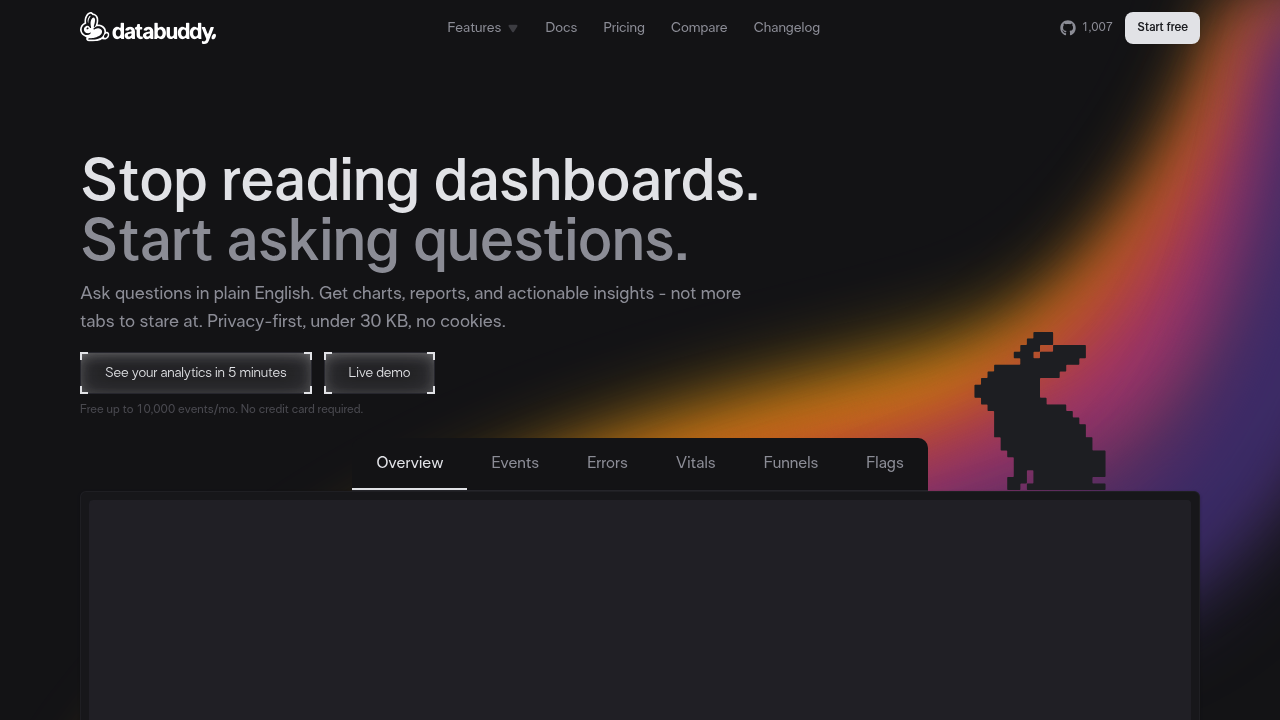
Databuddy sits at the intersection of privacy compliance and actionable AI insights — a combination that's rarer than it should be. The platform operates entirely without cookies or fingerprinting, making it fully GDPR and CCPA compliant by default without requiring consent banners.
What sets it apart in the AI context is Databunny, its embedded NLP-powered insights engine. Rather than forcing you to construct queries or navigate nested report views, Databunny surfaces contextual suggestions and answers directly in the dashboard. You're getting proactive pattern recognition alongside real-time user session monitoring — not just reactive metrics dumps.
Beyond AI insights, Databuddy includes conversion funnel analysis, feature flag management, error tracking, and Core Web Vitals monitoring — all in a single lightweight package. Companies like OpenCut and BETTER-AUTH already rely on it, and it's free to start.
If you're comparing it against other platforms, the Databuddy comparisons page covers feature-by-feature breakdowns against GA4, Mixpanel, PostHog, and others.
Best for: Developers and engineering-led teams who want AI-assisted insights without the privacy compliance overhead.
2. Amplitude — agentic AI for product analytics
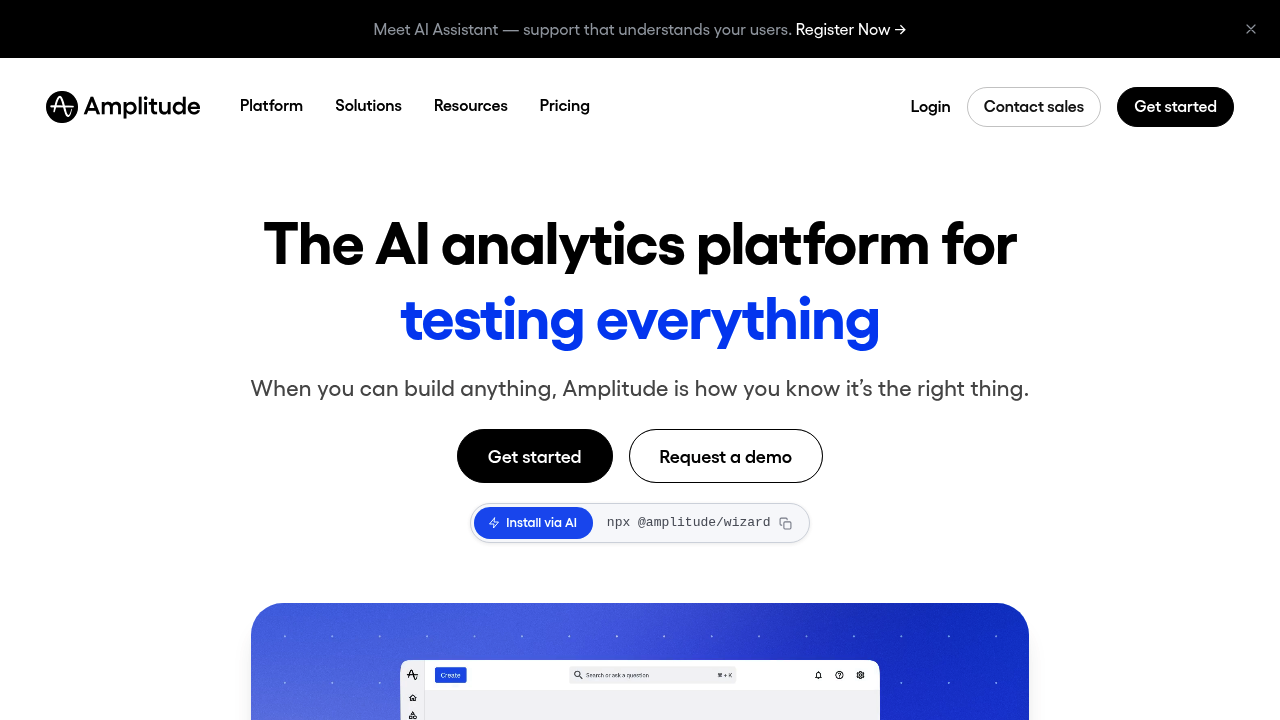
Amplitude shipped agentic AI analytics in February 2026, moving from passive reporting to autonomous analysis. The platform now includes a Dashboard Monitoring Agent that detects meaningful changes, a Session Replay Agent that proactively identifies user friction and estimates revenue impact, and an Experimentation Agent that automates A/B test design and analysis.
Its Predictive Cohorts feature — powered by Nova AutoML — lets teams group users by predicted future behavior (churn risk, conversion likelihood) rather than just past actions. This means you can build audiences and trigger interventions before a user actually churns, not after.
Amplitude has 4,700+ customers as of Q4 2025, with 698 paying over $100K ARR annually. The platform is deeply capable, but pricing scales quickly for high-volume products. It's also worth noting that Amplitude's data model requires substantial instrumentation upfront.
Best for: Product teams at growth-stage or enterprise companies who need deep behavioral analytics with automated modeling.
3. Mixpanel — conversational analytics with LLM integration
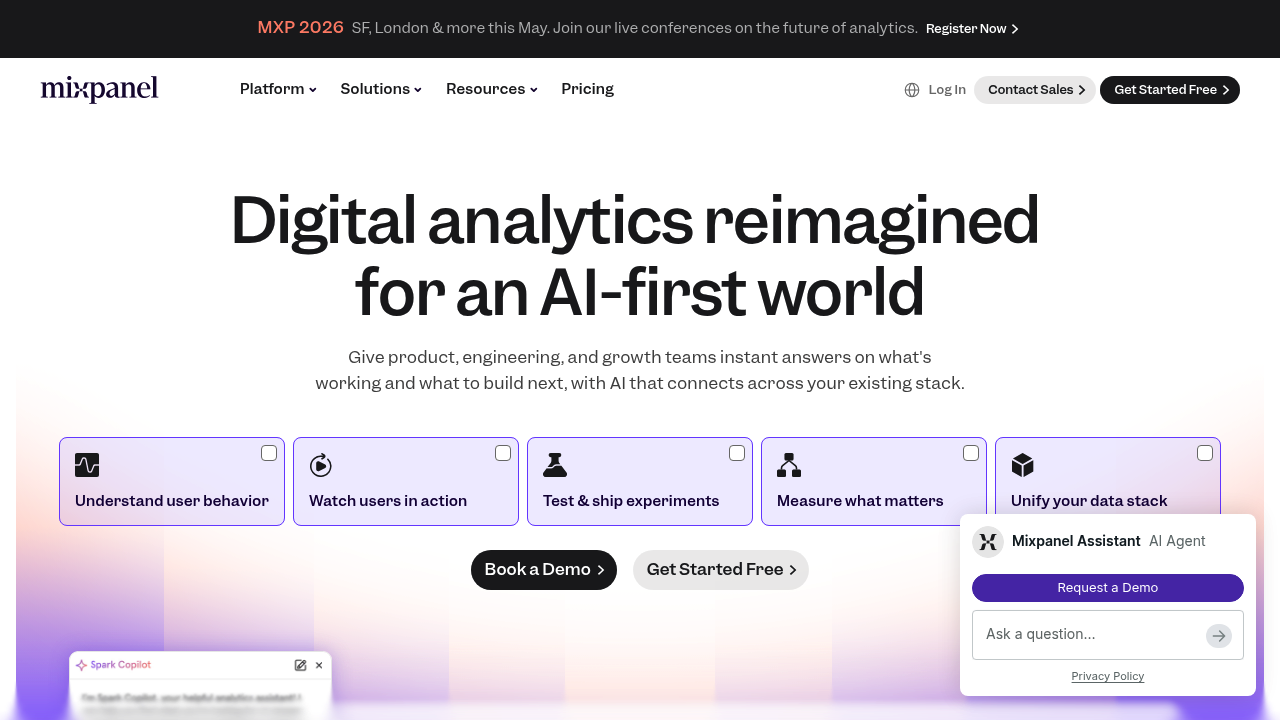
Mixpanel's approach to AI leans heavily into natural language interaction. Its Spark feature lets users "chat with their data" — constructing funnel reports, querying retention metrics, and asking follow-up questions in plain English. Notably, Mixpanel doesn't use client data to train public models, which is a meaningful data governance boundary.
In 2025, Mixpanel also launched an MCP (Model Context Protocol) server, connecting tools like Claude and Cursor directly to your Mixpanel data for context-aware behavioral queries. A SiliconANGLE report from June 2025 noted that the expanded platform also added automated anomaly detection, metric trees for centralized definitions, and AI-powered session replay integration.
Mixpanel focuses on diagnostic intelligence — understanding why a conversion dropped, not just that it dropped. If you want long-term market forecasting, you'll need to look elsewhere. But for fast, behavioral root-cause analysis, it's very strong.
If you're coming from Mixpanel, Databuddy has a detailed Mixpanel migration comparison covering what carries over and what you'd gain on the privacy side.
Best for: Product and growth teams who prioritize fast qualitative root-cause analysis over predictive modeling.
4. Google Analytics 4 — predictive metrics and generated insights
GA4 has made real AI advances since the January 2025 "Generated Insights" update. The feature now goes beyond anomaly flagging to explain anomalies in plain language — analyzing combinations of dimensions and metrics to tell you why conversions dropped, not just that they did.
The predictive metrics suite covers purchase probability (7-day window), churn probability, and 28-day revenue prediction per user. You can pipe these into Google Ads for predictive audience targeting — a meaningful closed-loop workflow if you're already running Google media.
There's an important caveat for EU-focused teams: GA4's AI data modeling uses behavioral modeling to fill consent gaps, which processes inferred data from users who declined cookies. This works around consent mode, but it doesn't make GA4 fully GDPR-clean. Multiple European DPAs have flagged concerns about GA4's data transfers to US servers. Teams in strict regulatory environments are better served by a GDPR-compliant analytics alternative.
Best for: Teams deep in the Google ecosystem who need predictive audiences for Google Ads campaigns.
5. Contentsquare — enterprise AI for digital experience intelligence
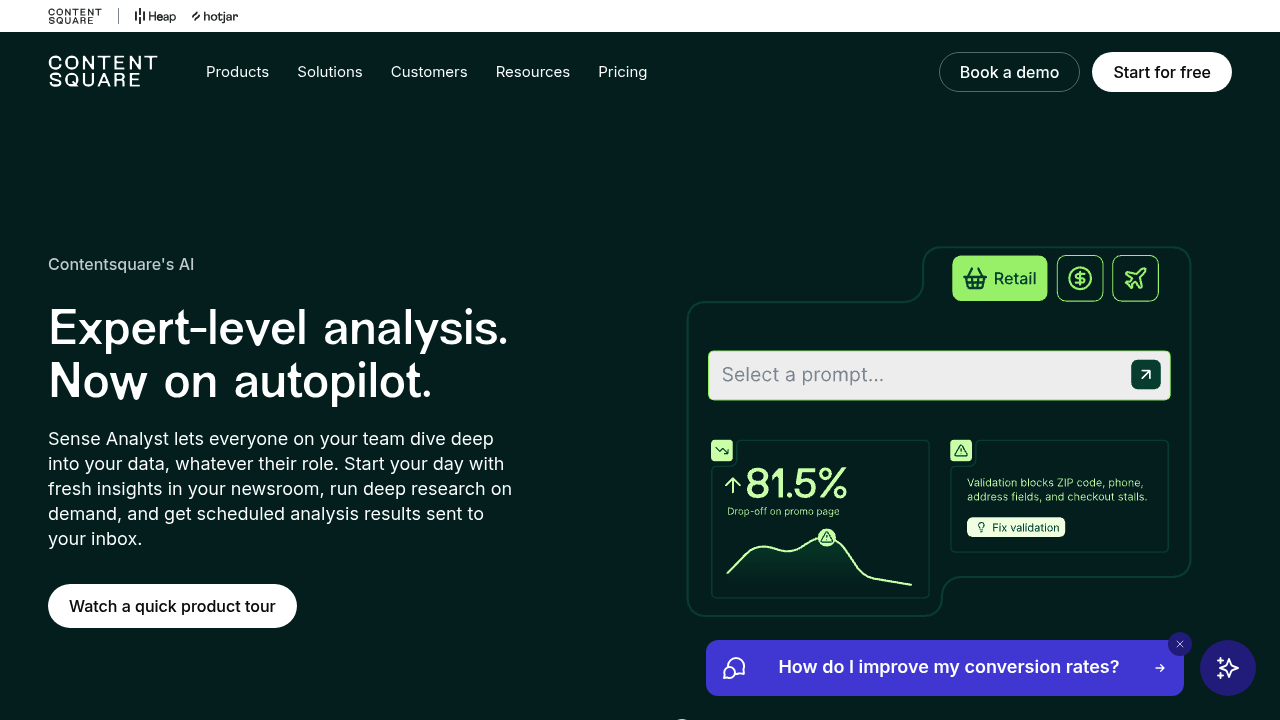
Contentsquare (which acquired Hotjar and Heap) launched its Sense Analyst agent in September 2025. According to a Business Wire press release from May 2025, Sense runs multi-step analyses autonomously — comparing user segments, identifying root causes, mapping journeys — and delivers findings to a proactive "Newsroom" feed without requiring manual configuration.
The platform also introduced LLM traffic tracking in March 2026, giving visibility into sessions arriving from AI-driven chat platforms like ChatGPT. Sense can summarize up to 100 session replays simultaneously and provides frustration scores (rage clicks, dead zones, errors) ranked 0–100 per page.
Contentsquare trains its AI models on aggregated, anonymized behavioral data and explicitly doesn't use client customer data to train external models — a meaningful enterprise compliance commitment. The tradeoff is cost: this is an enterprise product with enterprise pricing.
Best for: Enterprise UX, CX, and digital experience teams managing high-traffic properties with complex multi-page journeys.
6. Microsoft Clarity — free AI-assisted behavioral analytics
Clarity remains the most accessible entry point for AI-assisted heatmap and session analytics. It's free, unlimited in terms of session recording, and has been integrating AI features throughout 2025.
Key AI additions include Copilot-powered Heatmap Insights, which automatically summarizes behavior patterns across devices using generative AI. The August 2025 update also introduced AI traffic tracking — specifically monitoring and categorizing visits originating from AI chat platforms, which is increasingly relevant as LLM-driven referral traffic grows.
For teams on a budget, Clarity is hard to beat. The trade-off is that it doesn't integrate with a broader product analytics stack the way Amplitude or Mixpanel does, and data retention is capped at 13 months with a 100,000 pageview limit per heatmap.
Best for: Small teams and solo developers who want AI-assisted heatmaps and session intelligence at zero cost.
7. ThoughtSpot — search-first AI analytics
ThoughtSpot's Sage AI has long been the reference implementation for natural language querying in business intelligence. You type a question — "Which product pages had the highest exit rate in Q1 from mobile users in Germany?" — and get a structured, visualized answer without touching SQL or configuring a report.
Sage also provides automated insight generation: proactive alerts about anomalies and emerging patterns across connected datasets. For teams already warehousing their analytics data in Snowflake, BigQuery, or Databricks, ThoughtSpot layers AI-driven querying on top of existing data without forcing another data ingestion pipeline.
The downside is that ThoughtSpot is a BI tool with web analytics capabilities layered on, not a native web analytics platform. Setup requires data engineering resources and assumes a mature data infrastructure.
Best for: Data-mature organizations that want conversational BI on top of existing warehouse data, including web analytics streams.
How to choose the right tool for your stack
The "best" AI-powered analytics tool is a function of what you're optimizing for:
| Scenario | Recommended tool |
|---|---|
| Privacy compliance + AI insights, developer-friendly | Databuddy |
| Deep product behavioral analytics + agentic AI | Amplitude |
| NLP queries + behavioral root-cause analysis | Mixpanel |
| Google Ads audience integration + predictive metrics | GA4 |
| Enterprise digital experience intelligence | Contentsquare |
| Free AI-assisted heatmaps | Microsoft Clarity |
| Conversational BI on data warehouse | ThoughtSpot |
A few things to watch for when evaluating AI claims specifically:
Data governance: Does the vendor use your data to train external models? Most serious platforms (Mixpanel, Contentsquare, Databuddy) have explicit policies against this. Verify before you sign.
Privacy compliance surface: AI modeling that fills consent gaps (like GA4's behavioral modeling) may create compliance ambiguity in the EU. If you're operating under GDPR, cookieless analytics removes that ambiguity entirely.
Setup cost vs. signal quality: Amplitude and Contentsquare require substantial instrumentation investment before AI features become useful. Databuddy and Clarity can generate meaningful AI-assisted insights much earlier in the implementation lifecycle.
Integration with your existing tooling: Amplitude's MCP integration with Claude and Cursor, and Mixpanel's similar MCP server, are increasingly relevant for developer teams already working in AI-assisted environments. Databuddy's OpenAI SDK integration fits naturally into AI product pipelines.
The privacy dimension of AI analytics
Here's a tension that doesn't get discussed enough: AI insights typically require more data to generate higher-quality signals. But collecting more data conflicts directly with privacy regulations and user trust.
Tools like GA4 and Amplitude resolve this by collecting extensive behavioral data and applying AI downstream. That approach works, but it exposes you to GDPR and CCPA compliance risks, consent management complexity, and data governance overhead.
Databuddy takes the opposite position: collect minimally, process locally, and apply AI insights on anonymized, aggregated data. The result is fewer raw signals but zero compliance surface area. For teams building in privacy-sensitive verticals (healthcare, fintech, edtech), or those operating in the EU, this trade-off often makes more sense than it's given credit for.
The AI analytics landscape in 2026 isn't really about which tool has the most features. It's about which tool generates actionable signal from data you're actually allowed to collect — and does it in a way your engineering team can maintain without hiring a dedicated data scientist.
That's the bar worth holding these tools to.