
The best PostHog alternative depends on which part of PostHog you use. If you only open the web analytics tab, Plausible or Fathom give you a cookie-free traffic dashboard. If you live in funnels, retention, feature flags and experiments, Mixpanel's free plan covers all four; Amplitude's covers funnels, retention and flags, with experiment results starting on its Growth plan. Umami has a free hosted plan for web analytics (100K events a month), Matomo is the one to run on your own server, and Microsoft Clarity records sessions and heatmaps for free.
PostHog bundles a dozen products, and most teams that look for an alternative use two or three of them. This list sorts eight PostHog alternatives by that slice, compares them on cookies, self-hosting, session replay, feature flags, experiments and free tier, and gives each one drawback you can check at the linked source. Every vendor fact was checked on the vendor's own pages on 20 November 2026. Databuddy publishes this list and is included in it.
PostHog alternatives at a glance
- Plausible: a one-page traffic and goals dashboard without cookies. Best for teams that only used PostHog's web analytics. Drawback: no free cloud plan, only a 30-day trial.
- Fathom: cookie-free website analytics from $15 a month. Best for a hosted dashboard you never have to configure. Drawback: hosted only; you cannot keep the data on your own servers.
- Umami: MIT-licensed web analytics with a free hosted plan of 100K events a month. Best for free web analytics, hosted or self-hosted. Drawback: session replay and heatmaps start on the $200-a-month Business plan.
- Matomo: a wide set of web analytics reports, free to run on your own server. Best for self-hosting. Drawback: heatmaps, session recording and A/B testing are paid plugins.
- Mixpanel: product analytics with replay, experiments and feature flags on every plan. Best for funnels and retention. Drawback: its browser library keeps a cookie for 365 days by default.
- Amplitude: product and web analytics with the largest free event allowance here, 2M a month. Best for teams that want PostHog's breadth from a different vendor. Drawback: the Free plan allows 10 saved charts and one active experiment.
- Microsoft Clarity: free session recordings and heatmaps with no traffic limits. Best as the replay half of a PostHog setup. Drawback: visits from the EEA, UK and Switzerland need a consent signal for full tracking.
- Databuddy: one cookieless script for traffic, custom events, funnels, session replay and feature flags, with SDK adapters that keep PostHog's method names. Best for moving a PostHog integration without rewriting call sites. Drawback: hosted only, with no in-app surveys.
Best PostHog alternative by use case
| What you use PostHog for | Best fit |
|---|---|
| The web analytics tab, no cookies | Plausible or Fathom |
| Web analytics on a free plan | Umami |
| Web analytics on your own server | Matomo or Umami |
| Funnels, retention, flags and experiments | Mixpanel or Amplitude |
| Session replay and heatmaps, free | Microsoft Clarity |
| Your existing PostHog calls, on a cookieless script | Databuddy |
| Product analytics you host yourself | See the self-hosted analytics comparison |
If the reason you are leaving is the license or where the code lives, the open-source analytics shortlist compares these projects by license and hosted plan instead.
PostHog alternatives compared
PostHog is the first row for reference. "Not listed" means the vendor's pricing and feature pages do not offer it. Sources are linked in each tool's section.
| Tool | Cookies by default | Self-hosting | Session replay | Feature flags | Experiments | Free tier |
|---|---|---|---|---|---|---|
| PostHog | First-party cookie for 365 days, plus localStorage | MIT Docker Compose, officially unsupported | Yes, 5K recordings free | Yes, 1M requests free | Yes, billed with flags | 1M events a month, plus per-product allowances |
| Plausible | No cookies | Community Edition (AGPL) | Not listed | Not listed | Not listed | None; 30-day trial, then from $9 a month |
| Fathom | No cookies | No | Not listed | Not listed | Not listed | None; 7-day trial, then from $15 a month |
| Umami | No cookies | Yes, free | Business plan and above | Not listed | Not listed | 100K events a month, 1 website |
| Matomo | First-party cookies, can be disabled | Yes, free core | Paid plugin | Not listed | Paid plugin | Free On-Premise core |
| Mixpanel | Cookie for 365 days | Not listed | 10K replays a month free | Up to 10 active flags free | Up to 1k MEU a month free | 1M events a month |
| Amplitude | AMP_ cookies | Not listed | 10K replays a month free | Unlimited | 1 active experiment free | 2M events a month |
| Microsoft Clarity | First-party cookies once consent is given | Not listed | Yes, free | Not listed | Not listed | Free, no traffic limits |
| Databuddy | No analytics cookies; random ID in localStorage | No | 5,000 recordings a month on every plan | Yes | Variants, with per-variant goal results through MCP | 10,000 events a month |
Plans and allowances change. Check the linked pricing page before you commit; Databuddy's plans are on its pricing page.
What PostHog gives you before you switch
Know what you would give up. PostHog's pricing page lists a free allowance every month of 1M analytics events, 5K session recordings, 1M feature flag requests, 100K error tracking exceptions and 1,500 survey responses, with experiments billed with feature flags. No card is required, usage stops at the free limits, and the free plan has 1 project and 1-year data retention.
Two details send people looking. By default, PostHog's JavaScript library stores its state in localStorage and a first-party cookie named ph_<project_token>_posthog that expires after 365 days; you can switch to memory persistence until a visitor consents. And the self-hosting docs call self-hosted deployments officially unsupported, say all paid-plan features are Cloud-only, and ask for a machine with 4 vCPU and 16GB RAM.
If PostHog's free allowances cover you and the cookie is not a problem, staying is a reasonable choice. For a side-by-side with one alternative, see Databuddy vs PostHog.
Plausible: the web analytics tab, without cookies
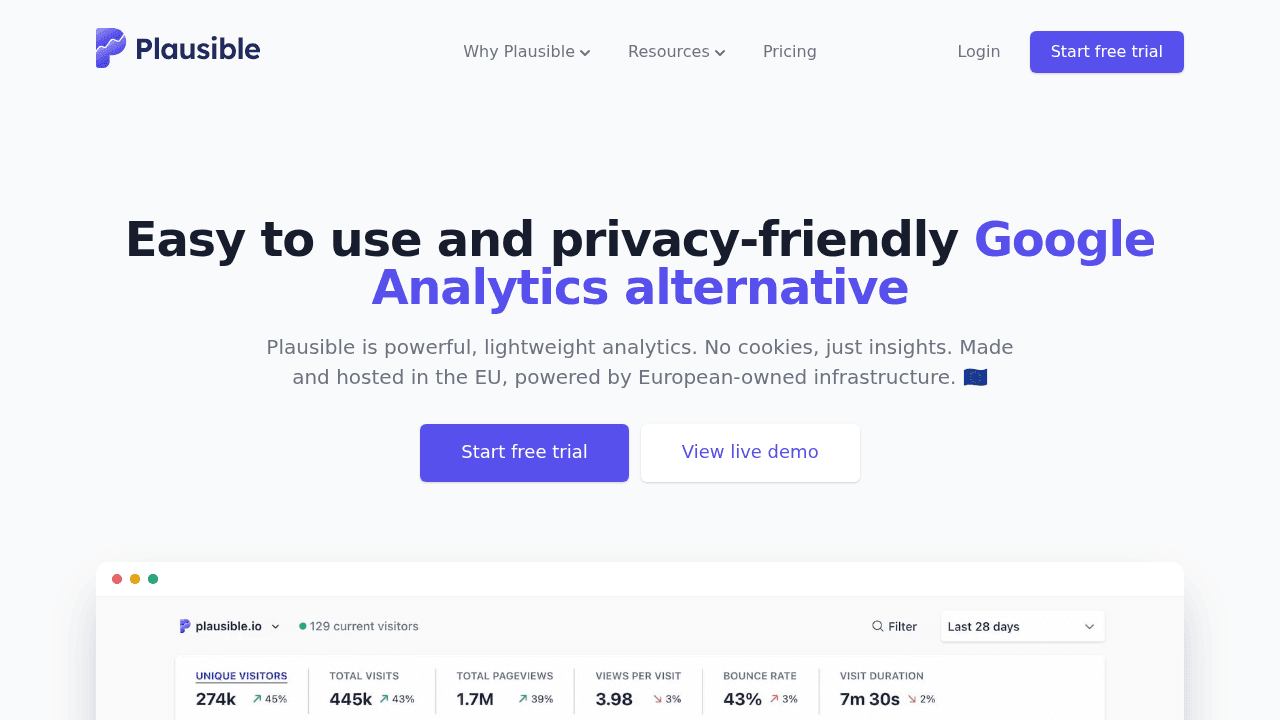
Plausible puts visitors, sources, pages, locations, devices and goals on one page. Its homepage says it uses no cookies and does not collect personal data, and its data policy says you do not need cookie banners for analytics with it. The cloud Starter plan starts at $9 a month for up to 10k monthly pageviews.
You can also run it yourself: Plausible Community Edition is the free, AGPL-licensed release that you host and manage.
Drawback: there is no free cloud plan. Plausible's pricing starts with a 30-day free trial, with no credit card required.
Plausible fits a team whose PostHog use never went past the web analytics dashboard. For a feature-by-feature view, see Databuddy vs Plausible.
Fathom: hosted, cookie-free, nothing to configure
Fathom is website analytics without cookies; its site says that means no consent banner for analytics. Its pricing starts at $15 a month for up to 100,000 monthly pageviews across 50 sites, and every plan has the same features. Plans start with a 7-day free trial that needs a card, and Fathom says plainly that it does not offer a free plan.
Drawback: you cannot host the data yourself. Fathom's features FAQ answers "Can I host the data locally?" with "No. Fathom is a hosted product."
Choose Fathom when you want a hosted dashboard and someone else running it. For a feature-by-feature view, see Databuddy vs Fathom.
Umami: free web analytics, hosted or on your server
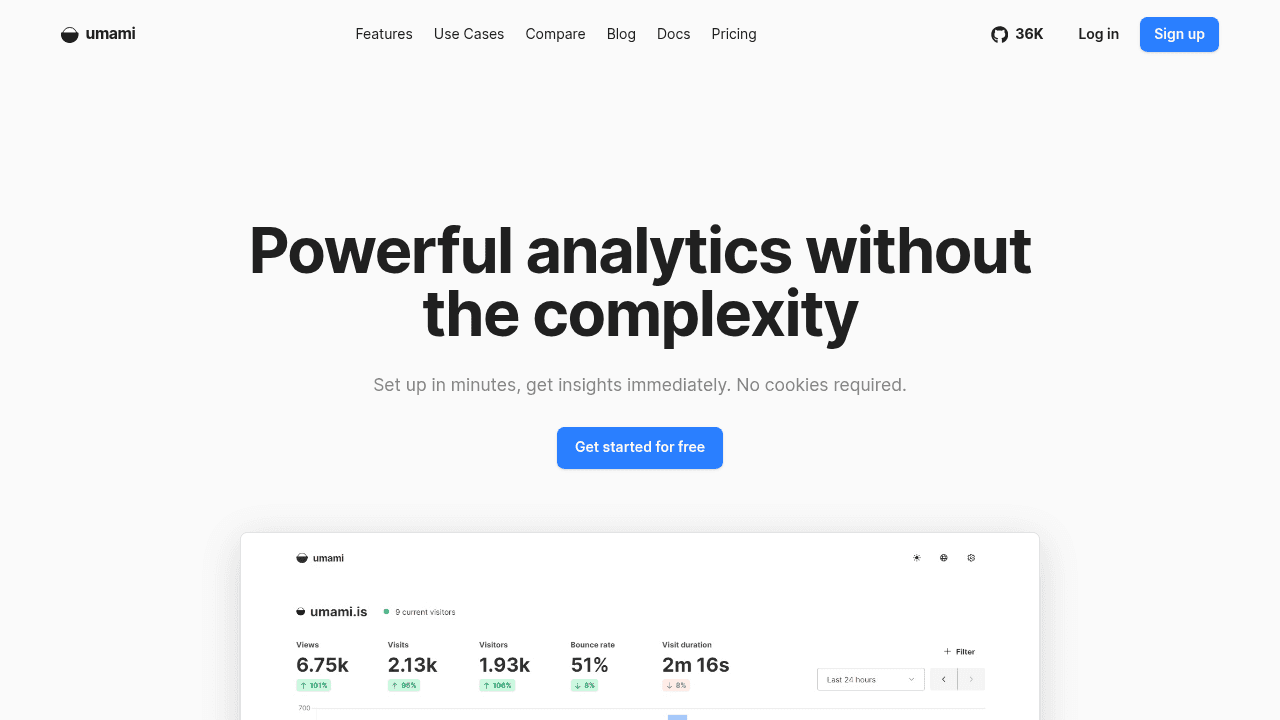
Umami's pricing page lists a free Hobby plan with up to 100K events a month for 1 website and 6 months of data retention. Pro costs $20 a month for 1 million events and up to 20 websites. Umami says it does not use cookies, and it can be self-hosted for free; the Cloud adds features such as email reports and the streaming API.
Drawback: session replays and heatmaps are on the Business plan ($200 a month, 5,000 replays included) and Enterprise only. The free Hobby plan has neither.
Umami fits a team that wants PostHog's web analytics for free and does not need replay. For a feature-by-feature view, see Databuddy vs Umami.
Matomo: the full report set on your own server
Matomo On-Premise is free forever with unlimited users and hits, according to its pricing page. The tracking code sets first-party cookies by default, including _pk_id, which stores a visitor ID for 13 months; Matomo's cookie FAQ says the default cookies can be disabled.
Drawback: the replay and testing parts of PostHog cost extra. On the On-Premise pricing, Heatmaps & Session Recording is in the paid Team bundle, and A/B Testing is in the Enterprise bundle.
Matomo fits a team that wants web analytics on its own server and is willing to pay for the replay and testing plugins. Server sizing and licenses are in the self-hosted analytics comparison. For a feature-by-feature view, see Databuddy vs Matomo.
Mixpanel: product analytics with flags and experiments included
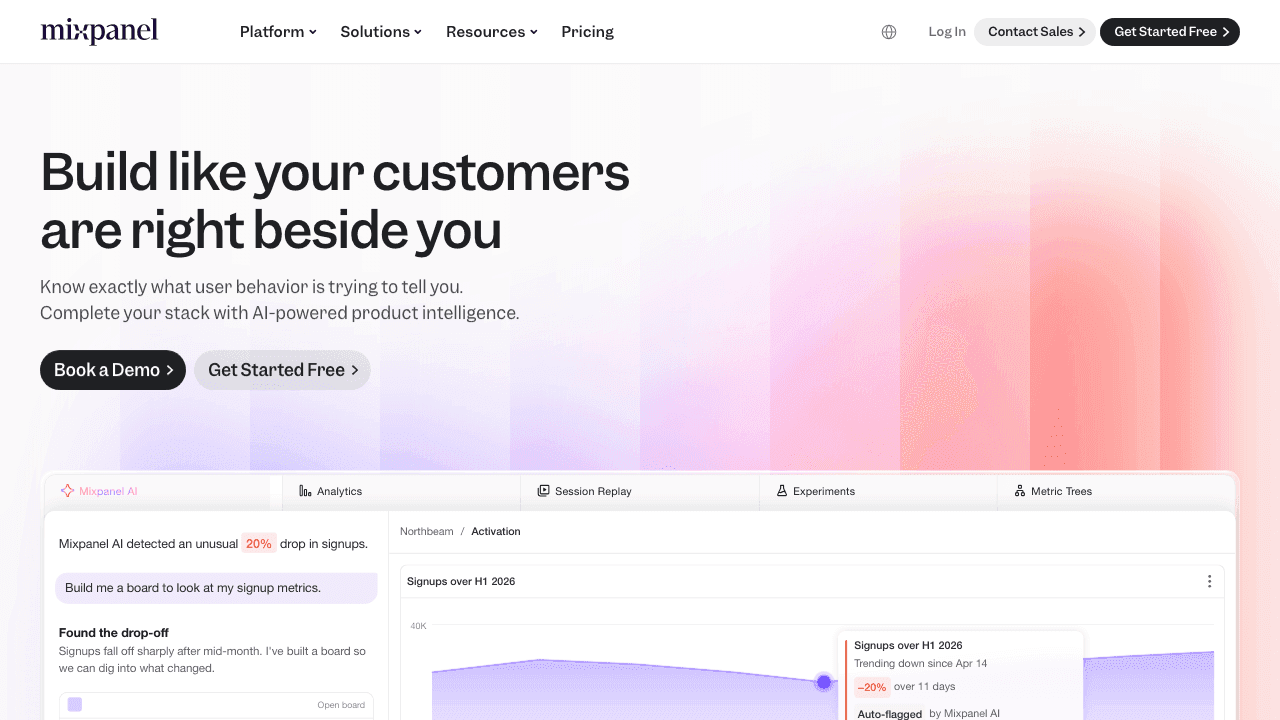
Mixpanel's pricing page says every plan includes analytics, session replay, heatmaps, experiments and feature flags. The Free plan has no credit card requirement and covers up to 1M events a month, 10K session replays a month, up to 1k monthly experiment users (MEU) and up to 10 active feature flags.
Drawback: plan for consent. Mixpanel's JavaScript SDK docs say super properties are stored in a cookie on your domain that lasts 365 days by default. You can switch persistence to localStorage, which is still browser storage.
Mixpanel suits product teams who used PostHog for funnels and retention and want flags and experiments next to them. For a feature-by-feature view, see Databuddy vs Mixpanel.
Amplitude: the biggest free event allowance
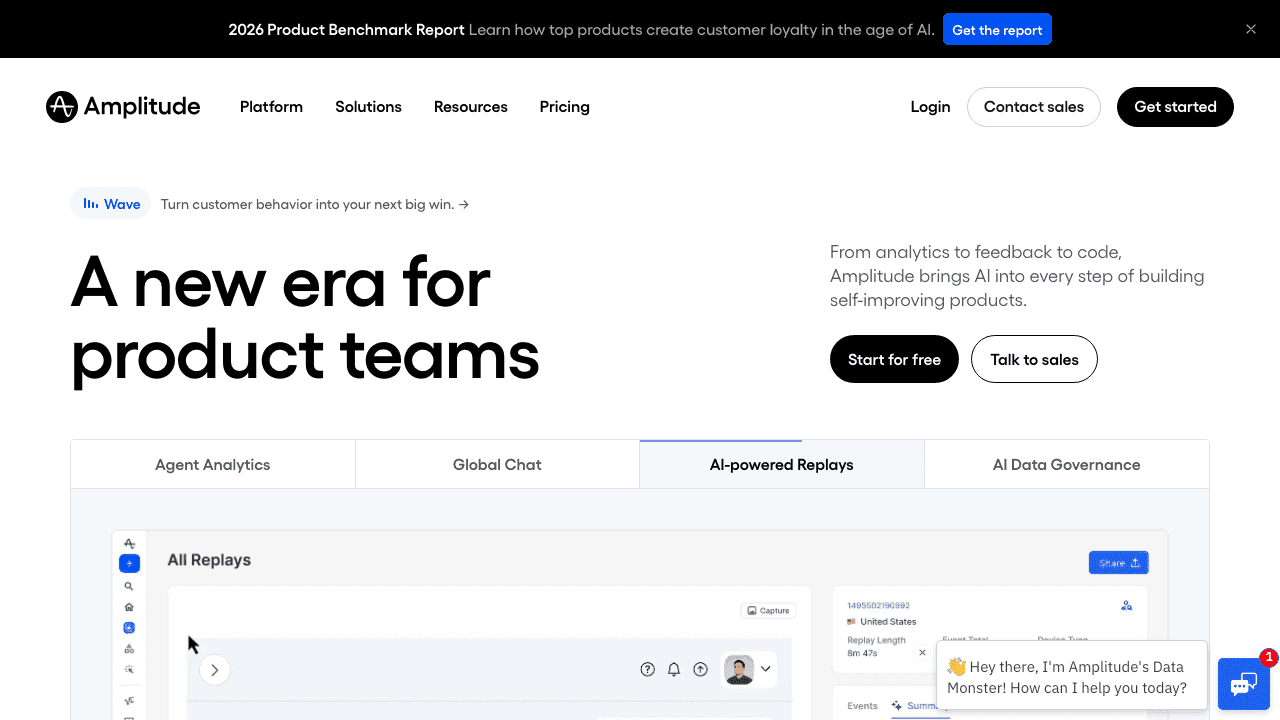
Amplitude's Free plan covers 2 million events a month with no credit card and no time limit. Its pricing page lists 10K monthly session replays, unlimited feature flags, and limited web experimentation, guides and surveys on that plan. The Browser SDK 2 sets cookies named AMP_ plus part of your API key.
Drawback: the Free plan is narrow in places. The same pricing page caps it at 10 saved charts per organization and 1 active experiment, and A/B/n testing starts on the Growth plan.
Amplitude fits a team that wants product analytics, replay and experiments from one vendor, as PostHog offers, with more free events. For a feature-by-feature view, see Databuddy vs Amplitude.
Microsoft Clarity: free session replay and heatmaps
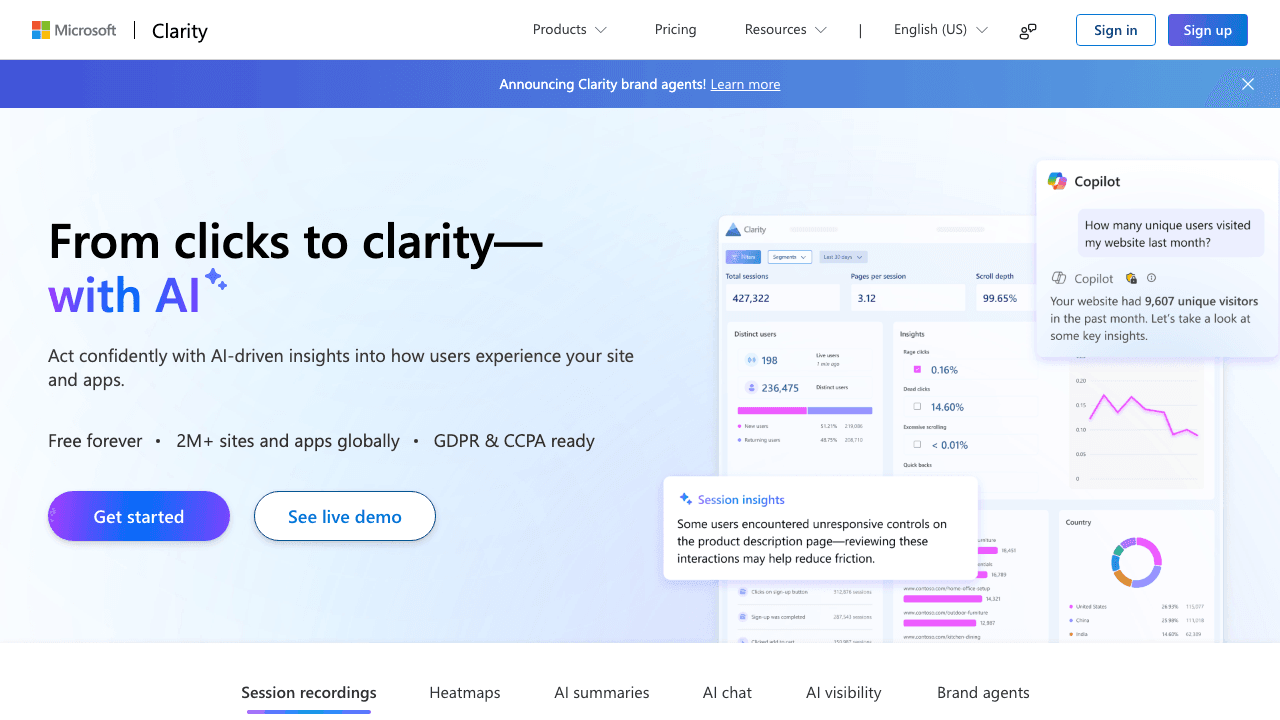
Clarity records sessions and builds heatmaps. Its FAQ says it is a free service forever, with no traffic limits and no limit on the number of sites. It sets first-party cookies such as _clck and _clsk, listed on its cookie page.
Drawback: since 31 October 2025, Clarity's consent documentation requires a valid consent signal for full functionality on visits from the EEA, UK and Switzerland. When consent is denied, Clarity sets no cookies and assigns a new ID per page view.
Clarity replaces PostHog's replay, not its analytics, so most teams pair it with one of the tools above.
Databuddy: keep your PostHog calls, drop the cookie
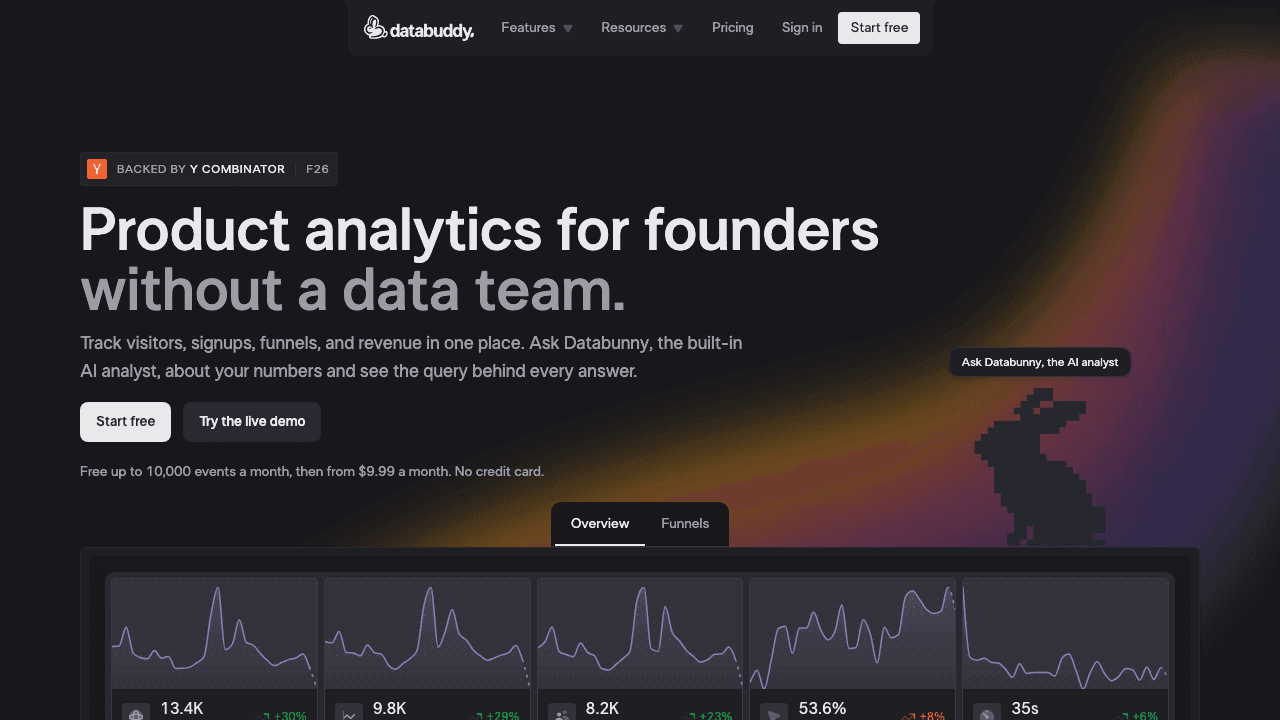
Databuddy is one cookieless script for visitors, custom events, funnels and goals, with error and Web Vitals tracking you can turn on. The tracker stores a random visitor ID in first-party localStorage instead of a cookie; the cookieless analytics guide explains what it stores and where consent can still apply.
For a team leaving PostHog, the useful part is the PostHog migration path. The @databuddy/sdk package ships adapters for posthog-js, posthog-js/react and posthog-node that keep PostHog's method names for capture, identify and feature flags, so most of the move is changing imports. The guide lists what maps differently, such as alias and nested traits.
Session replay is included on every plan with 5,000 recordings a month, and typed input is always masked. Feature flags support rollouts and variants, and the MCP get_experiment_results tool compares a goal across a flag's variants. Uptime monitoring and status pages are included too. The Free plan has 10,000 events a month; Hobby is $9.99 a month and Pro $49.99.
Drawback: Databuddy runs as a hosted service only, so you cannot self-host it, and it has no in-app surveys. If you rely on PostHog surveys or need analytics on your own server, it is not the right fit.
Compare it feature by feature on Databuddy vs PostHog, open the live demo, or create a free account and run it next to PostHog for a week.
How to switch from PostHog without losing data
Run the new tool next to PostHog before you remove anything. Send a known pageview and one custom event, then confirm both arrive in each tool. Expect visitor counts to differ, since cookie-based and cookie-free tools count visitors differently.
Export what you need to keep. Databuddy's history import accepts a PostHog batch export of events as JSON lines and rebuilds pageviews and sessions from the $pageview events; custom events, replay recordings and user profiles do not transfer that way. Check the import path of whichever tool you choose before you cancel PostHog.
Frequently asked questions
What is the best PostHog alternative?
It depends on the PostHog product you use. Plausible or Fathom for cookie-free web analytics, Mixpanel or Amplitude for product analytics with flags and experiments, Matomo or Umami to host it yourself, Microsoft Clarity for free replay, and Databuddy to keep your PostHog SDK calls.
What is the best free PostHog alternative?
Amplitude has the largest free allowance here, 2M events a month, and Mixpanel's Free plan has 1M. For web analytics only, Umami's Hobby plan covers 100K events a month. Microsoft Clarity is free for recordings and heatmaps. Databuddy's Free plan has 10,000 events a month.
Which PostHog alternative does not use cookies?
Plausible, Fathom and Umami say they use no cookies. Databuddy uses no analytics cookies and keeps a random visitor ID in localStorage. Mixpanel, Amplitude, Matomo and Clarity set cookies by default, and Matomo's can be disabled. Cookie-free is not the same as consent-free; check what each tracker stores and collects.
Is there a self-hosted PostHog alternative?
Yes. Matomo On-Premise, Umami and Plausible Community Edition are free to self-host. For product analytics on your own server, the self-hosted analytics comparison covers OpenPanel and PostHog's own deployment, with server requirements for each.
Which PostHog alternative has feature flags and experiments?
Mixpanel includes both on every plan, with up to 10 active flags and 1k MEU for experiments on Free. Amplitude's Free plan has unlimited flags and one active experiment. Databuddy has feature flags with variants, and compares a goal across variants through its MCP tools. Matomo sells A/B Testing as a paid plugin.